

Remembrance of a Reformer
July 6 is a national holiday in the Czech Republic commemorating the anniversary of the death of Jan Hus (c. 1370–1415), one of the most influential figures in Czech history.
Although there are no large nationwide celebrations, commemorative ceremonies and church services are held in several locations, particularly at Bethlehem Chapel in Prague. Jan Hus remains an important figure in Czech history, and many Czechs regard him as one of the nation’s greatest historical figures.
Hus is significant not only in Czech history but also in the broader history of Western Christianity. His teachings and calls for reform anticipated many of the ideas that would later emerge during the Protestant Reformation of the 16th century.
Very little is known about Hus’s early life. He was born to peasant parents in South Bohemia and is believed to have been educated at a monastery from around the age of 10.
Later, he relocated to Prague and earned a Master of Arts degree at the University of Prague in 1396. Two years later, he began lecturing at the university.
Hus was ordained as a Catholic priest in 1400 and became dean of the university’s Faculty of Philosophy in 1401 before being elected rector in 1402.
That same year, Hus was appointed preacher at Bethlehem Chapel, a building that still stands today in Prague’s Old Town. Through his preaching in Prague and throughout Bohemia, he attracted a large and devoted following.
Jan Hus drew considerable inspiration from the writings of English theologian and reformer John Wycliffe (c. 1328–1384). Like Wycliffe, Hus believed that people should hear the Gospel in their own language rather than exclusively in the Latin traditionally used by the Church. Despite repeated warnings from his superiors, Hus preached in Czech so that ordinary people could understand his message. He also promoted the use of Czech in religious writings and contributed to the development of Czech biblical texts and orthography, making Scripture more accessible to both clergy and ordinary people.
In addition to preaching in the local language, Hus advocated reform within the Church itself. Opulence, political intrigue and corruption were widespread among some senior clergy, and Hus believed the Church should return to a simpler and more faithful expression of Christianity.
It is important to remember that Hus remained a devout Catholic throughout his life. His goal was not to establish a new church but to reform the existing one from within.
Making of a Martyr…and a Movement
King Wenceslaus IV ruled Bohemia from 1378 to 1419. His reign coincided with the Western Schism (1378–1417), during which rival popes in Rome and Avignon each claimed legitimacy as head of the Catholic Church. European rulers, nobles, and clergy were forced to support one claimant or the other.
Wenceslaus supported the Avignon papacy, while the Archbishop of Prague remained loyal to Rome. This disagreement further strained relations between the king and the Church.
The king’s poor relationship with Church authorities also contributed to his willingness to support Hus’s calls for reform, and he resisted demands from the Roman Catholic Church to denounce Hus and his followers as heretics.
In 1414, Hus was summoned to the Council of Constance after receiving a letter of safe conduct from King Sigismund of Hungary and later Holy Roman Emperor, who promised him safe passage. Despite this assurance, Hus was arrested upon his arrival, tried for heresy, and burned at the stake on July 6, 1415.
His execution sparked outrage throughout Bohemia. Hus’s teachings had resonated deeply with many people, and his death transformed him into a martyr. In the years that followed, his supporters organised into what became known as the Hussite movement, a reform movement that foreshadowed many later Protestant ideas.
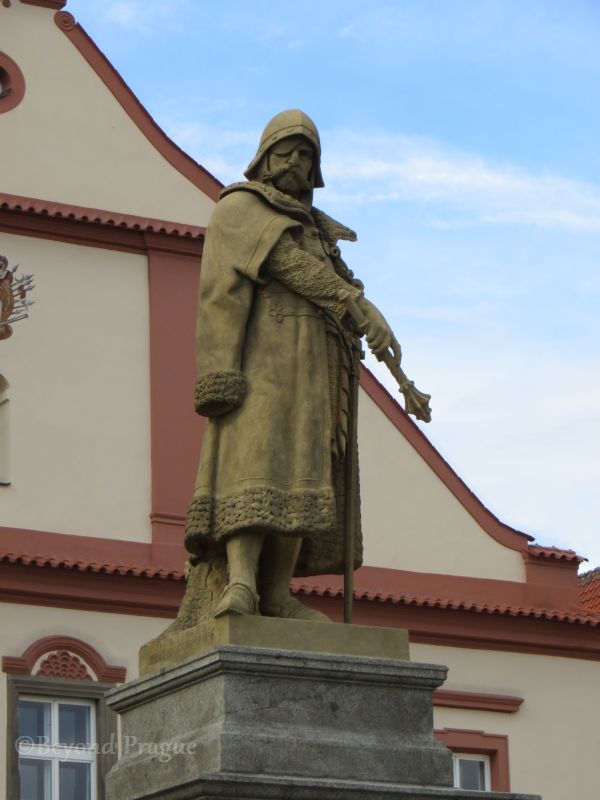
Hussite Wars
The Hussites faced immediate persecution following Hus’s execution. This was due in part to King Wenceslaus IV abandoning his earlier support for Hus’s reforms. Where Hus’s followers had once occupied influential government positions, the king now worked to remove them from public office.
In June 1419, a group of Hussites led by the priest Jan Želivský stormed Prague’s New Town Hall and threw several town councillors and royal officials from its windows to the street below, killing several of them. This event became known as the First Defenestration of Prague and sparked the Hussite Wars, which lasted from 1419 to 1434.
The Hussite Wars consisted of a series of crusades launched against Bohemia. Despite being outnumbered, the Hussite armies—most famously under the leadership of Jan Žižka—successfully resisted repeated invasions by imperial and papal forces through innovative tactics and determined leadership.
Although the wars eventually ended without a decisive military victory for either side, agreements such as the Compactata of Basel established an unusual degree of religious coexistence for the period by permitting moderate Hussites to continue many of their religious practices. The Hussite movement remained an influential force within Bohemia until the Habsburg dynasty assumed control of the kingdom in 1526.
Habsburg Rule and the Thirty Years’ War
For much of the first century of Habsburg rule, relations between Catholics and Protestants in Bohemia remained relatively peaceful. The first two Habsburg rulers of Bohemia, Rudolf II (1552–1612) and Matthias (1557–1619), generally tolerated Protestantism and extended religious rights that allowed Protestant nobles to hold high office and maintain substantial estates.
Matthias was succeeded by his cousin Ferdinand II of Styria (1578–1637). Unlike his predecessors, Ferdinand was a committed supporter of the Counter-Reformation and intended to restore Catholicism as the dominant faith throughout his lands. He refused to honour many of the religious freedoms previously granted to Bohemia’s Protestant estates.
Relations between the Bohemian nobility and the Habsburg monarchy deteriorated rapidly. In 1618, three royal Catholic officials were thrown from the windows of Prague Castle during what became known as the Third Defenestration of Prague. Although the officials survived, the incident became one of the principal catalysts for the Thirty Years’ War (1618–1648), one of the most destructive conflicts in European history.
One of the war’s defining moments came in 1620 at the Battle of White Mountain near Prague. The decisive Catholic victory marked the beginning of two centuries of intensified re-Catholicisation and Germanisation in Bohemia.
Legacy of Jan Hus
Jan Hus’s influence extended far beyond his lifetime and well beyond the borders of his homeland. His legacy continues to shape Czech culture, language, religion, and national identity.
- Language and Literature: Hus was a proponent of the Czech language at a time when Latin and German dominated religious and scholarly life. By promoting Czech in sermons and religious writings, he helped make Christianity more accessible to ordinary people. He also played an important role in developing Czech orthography by introducing or popularising the use of diacritical marks, helping establish the written form of the language that continues to be used today.
- Symbol of National Identity: Hus became a powerful symbol of Czech resistance to foreign domination and a champion of national identity. During the Czech National Revival of the 18th and 19th centuries, historians and intellectuals such as František Palacký portrayed him as both a religious reformer and a national hero whose life embodied the Czech struggle for freedom.
- A Precursor to the Reformation: More than a century before Martin Luther, Hus challenged abuses within the Church, questioned unchecked papal authority, and argued that Scripture should take precedence over ecclesiastical hierarchy. Luther later studied Hus’s writings and acknowledged the Bohemian reformer as an important spiritual predecessor.
- Religious Tolerance: Although the Hussite Wars were devastating, they eventually produced a settlement that permitted moderate Hussite worship alongside Catholicism. While far from modern religious freedom, this arrangement represented a remarkably uncommon degree of religious coexistence in 15th-century Europe.
Today, Jan Hus remains one of the Czech Republic’s most revered historical figures. His commitment to conscience, truth, education, and reform continues to inspire people around the world more than six centuries after his death.


Thanks for the brilliant reminder of the massive legacy of Jan Hus! Christians today should celebrate the freedoms he initiated. Frank Carroll, Consul, Brisbane.