

Hearts and Bones
Poděbrady is a city of about 15,000 people located roughly 40 kilometres east of Prague. It sits on the Labe (Elbe) River and is one of the Czech Republic’s many spa towns.
The first mineral springs were discovered in 1905, and the first spa opened three years later, in 1908. From its founding, Poděbrady quickly built a reputation at home and abroad for high-quality spa treatments.
Most spa towns specialize in treating particular bodily systems. In the case of Poděbrady, those are the cardiovascular and musculoskeletal systems. The healing waters here are noted for their alkaline nature and high levels of carbon dioxide, sodium-calcium chloride, and iron. There are 12 public taps around town where you can freely sample the spring water. A bottled version, Poděbradka, is widely available for purchase across the country.
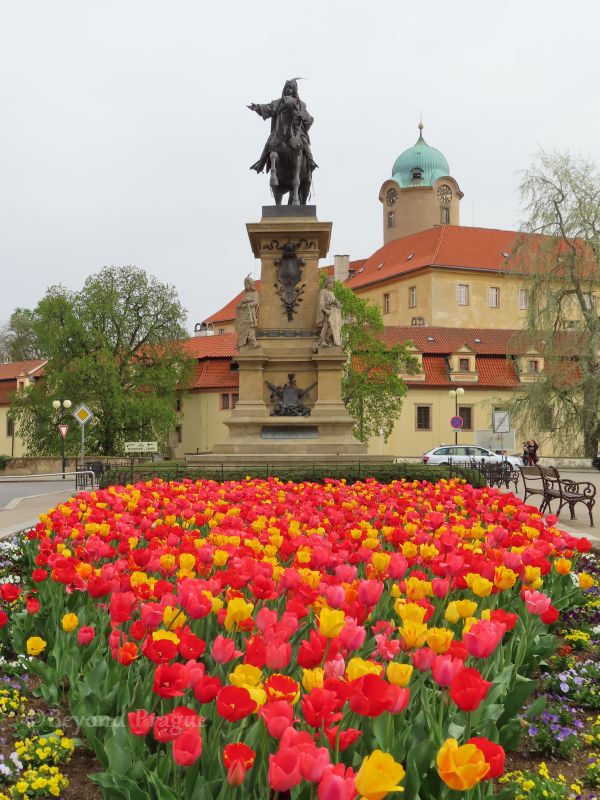
Life Before the Spas
While the discovery of mineral springs and the establishment of spas gave Poděbrady prominence going into the 20th century, the town was well known long before that.
The first written mention of Poděbrady dates to 1223. It was a popular retreat for the Bohemian nobility thanks to its rich hunting grounds and proximity to Prague.
In the 1260s, Poděbrady became the property of King Otakar II of Bohemia after the previous owner died without heirs. Under Otakar II, the town’s castle was built.
The town remained under crown ownership until around 1350, when King Charles IV gifted it to the noble House of Kunštát. Around this time, the Poděbrady branch of that family line was established.
The most significant historical figure associated with the town, Jiří z Poděbrad (George of Poděbrady), was born here in 1420. He ruled as King of Bohemia from 1458 until his death in 1471. George was an outstanding diplomat and the first ruler to attempt to create a peaceful union among Europe’s monarchs. Although his plan did not succeed, it foreshadowed later efforts to unite Europe—culminating centuries later in the creation of the European Union in 1993.
George ruled at a time when Bohemia was religiously divided between the Hussite movement and the Catholic Church. Though he was a Hussite, he is remembered as a moderate and tolerant ruler who encouraged peace between the two sides. This earned him the nickname “King of Two Peoples.”
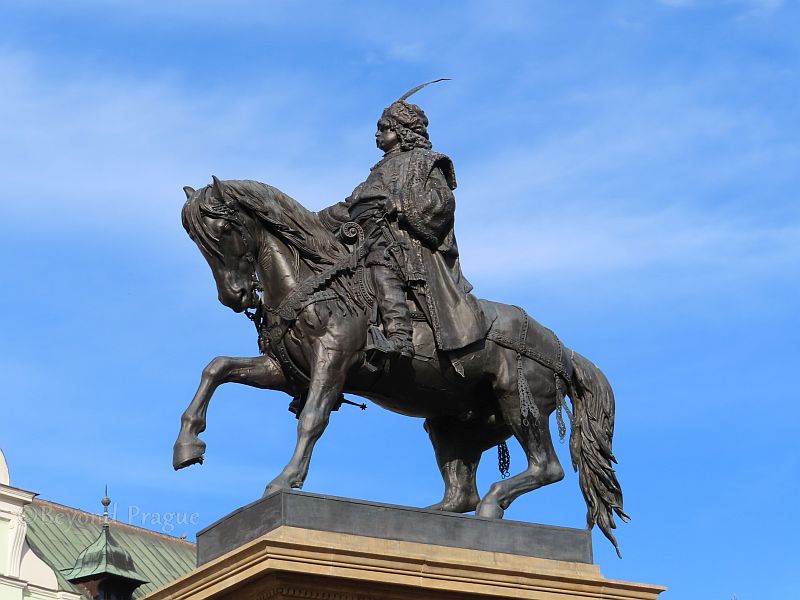
The town was elevated to city status near the end of George’s reign and continued to flourish under subsequent rulers until the 17th century, when the Thirty Years’ War brought devastation as Swedish and Saxon armies invaded the area.
Poděbrady’s appearance changed significantly after a major fire in 1681. Many wooden buildings, including the town hall, were destroyed and replaced with brick structures. Around the same time, the city walls were demolished and the moats filled in.
Empress Maria Theresa Habsburg visited Poděbrady several times during her reign. Between 1752 and 1757, she ordered the castle to be renovated to accommodate herself, her husband, and their entourage.
When Maria Theresa’s eldest son, Joseph II, inherited power, he converted the castle into a residence for retired officers of the imperial army.
The city experienced a brief downturn after fires in 1800 and 1832. The Poděbrady estate was later purchased, in 1840, by Austrian-Greek businessman and banker Georgios Sinas (1783–1856), under whom the city began to prosper again.
Sinas’s great-granddaughter, Princess Charicléa of Hohenlohe-Schillingfürst (née Ypsilanti), took up residence in the castle in 1885 with her husband. Their legacy was one of charity and compassion for the poor. The princess established a local fund for those in need, often used the castle kitchen to prepare meals for them, and founded an orphanage in the city. The couple owned the castle until the princess’s death in 1912, and they were its last private owners.
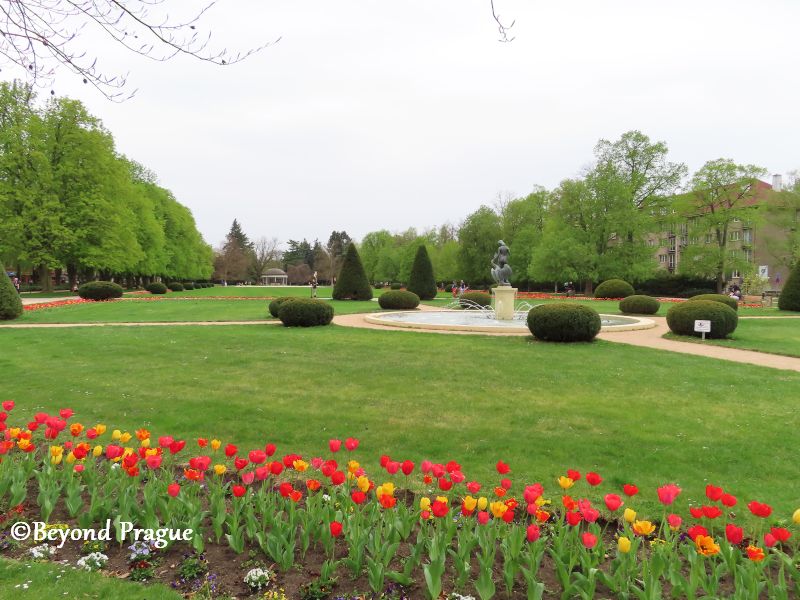
A Feel for the Place
As one might expect of a spa town, Poděbrady feels relaxed and unhurried. While it has a basic public transport system, it’s a city best explored on foot.
If you arrive by rail, the first attraction you’ll see is T. G. Masaryk Square, located directly across from the train station. The square connects to Lázeňský Park, forming a lovely green corridor between the station and the city centre. At the junction of the square and park, you’ll find the eye-catching Libenský Colonnade, one of several spots where you can sample the mineral spring water.
This is just one example of the abundance of green space in Poděbrady. The city offers several other parks, as well as walking and cycling trails along both banks of the river.
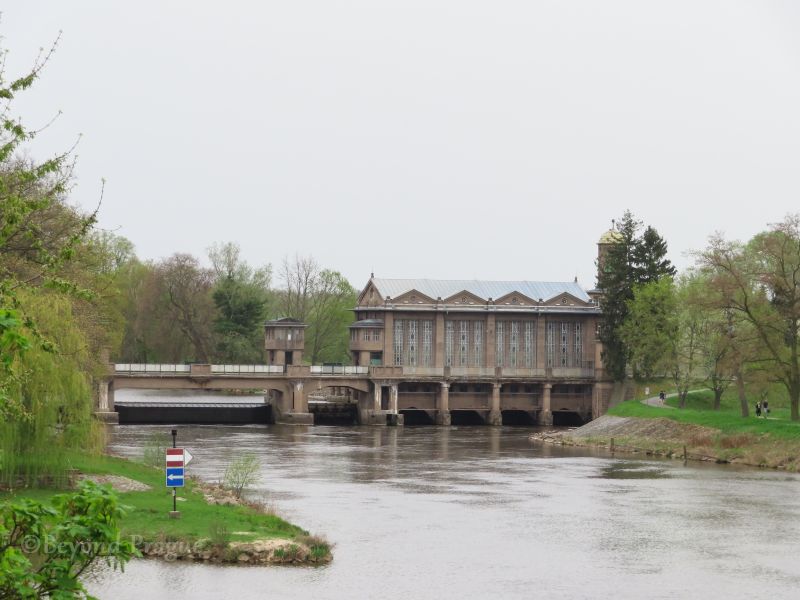
The area around the Labe is particularly pleasant, with pedestrian walkways on each side. While strolling along the river, you’ll also come across the historically important hydroelectric power station, built between 1914 and 1919 and still in operation today.
The power station, built in the Neoclassical style, has been listed as a national cultural monument since 2012 and is protected as part of the Czech Republic’s industrial heritage.
A walk along the city side of the riverbank will take you past a number of small pubs and cafés, as well as the dock for a riverboat that cruises between Poděbrady and Nymburk, the main city in the region.
The opposite bank offers scenic views of the castle, along with access to natural areas and a nearby lake.

To the Castle
Poděbrady Castle dates to the reign of King Otakar II in the late 13th century, when he ordered a stone water fortress to replace the wooden structure that had previously stood on the site.
In its early days, the fortress defended Prague from attacks coming from the east and northeast and controlled a strategically important crossing on the Labe River. During the Hussite Wars (1419–1434), the castle was unsuccessfully besieged in 1420 and again in 1426.
Like many Czech castles, Poděbrady’s evolved over the centuries from a practical fortification into a residence for the nobility.
Emperor Ferdinand I (1503–1564) ordered the castle to be rebuilt in the comfortable Renaissance style as a hunting lodge. It was damaged during the Thirty Years’ War (1618–1648) and declined in importance thereafter.
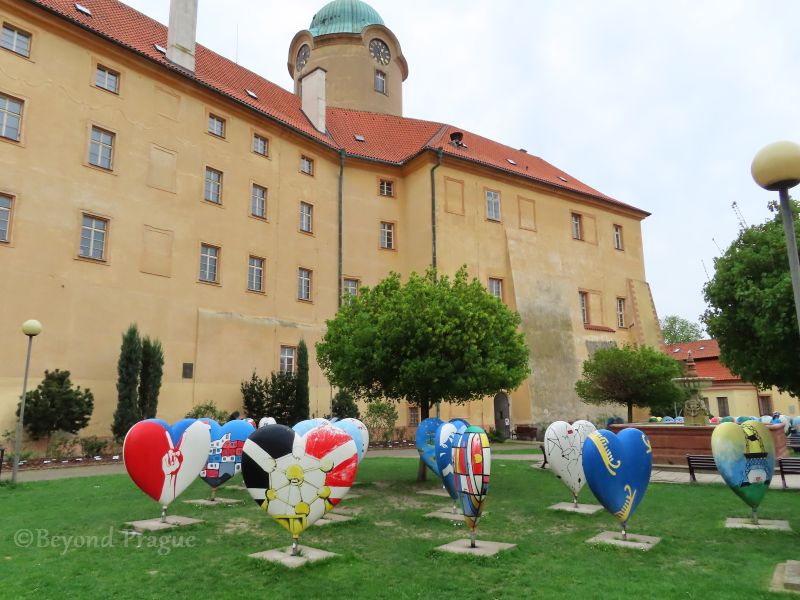
As noted earlier, Maria Theresa Habsburg later ordered another reconstruction, this time in Baroque style—a face the castle retains today.
Despite these transformations, the castle still presents a massive, formidable silhouette along the river.
Guided tours are available, including one dedicated to the legacy of George of Poděbrady, who was very likely born within its walls. During opening hours, visitors can freely enter the castle courtyard, where a permanent art installation features several heart sculptures, each decorated with motifs representing a nation of the European Union. The installation commemorates George’s early vision of European unity and celebrates the city’s long-standing connection to heart health.
Paying a Visit and Learning More
Poděbrady is easy to reach—it’s a stop on several train lines. The city’s main tourist information office is conveniently located in the train station, making it a good first stop for visitors arriving by rail.
The city offers a range of dining and accommodation options to suit most travellers. It’s large enough for a weekend getaway but compact enough for an easy day trip.
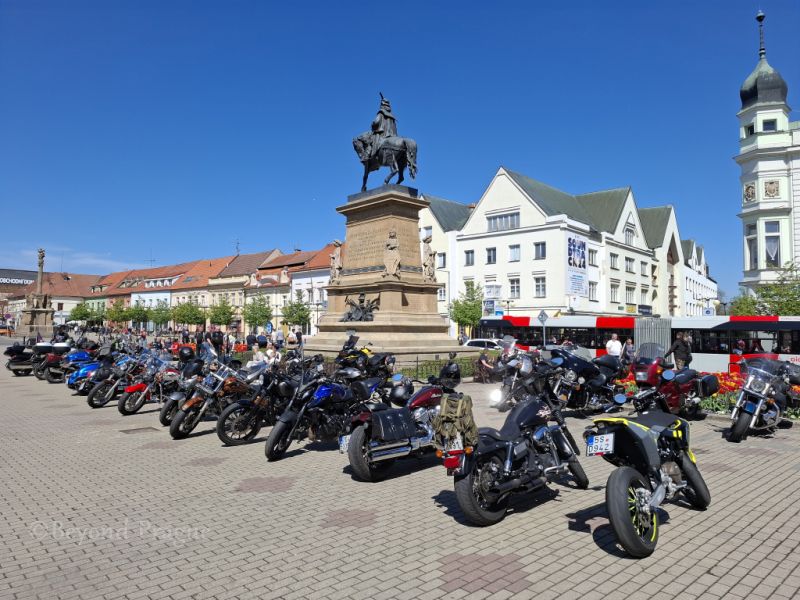
If you visit in spring or summer, be aware that Poděbrady is a popular lunch-hour gathering spot for motorcyclists on cross-country rides. They usually congregate on George’s Square (Jiřího náměstí).
If you enjoy motorcycles, you’ll appreciate the friendly atmosphere and the chance to see some fascinating machines. The downside is that the crowds can be noisy, and service at restaurants around the square may slow considerably.
To avoid the bustle, consider dining at one of the restaurants near T. G. Masaryk Square, Lázeňský Park, or along the city-side riverbank.
To learn more, visit Poděbrady’s official website, which is multilingual in Czech, English, French, German, and Russian.
 Beyond Prague