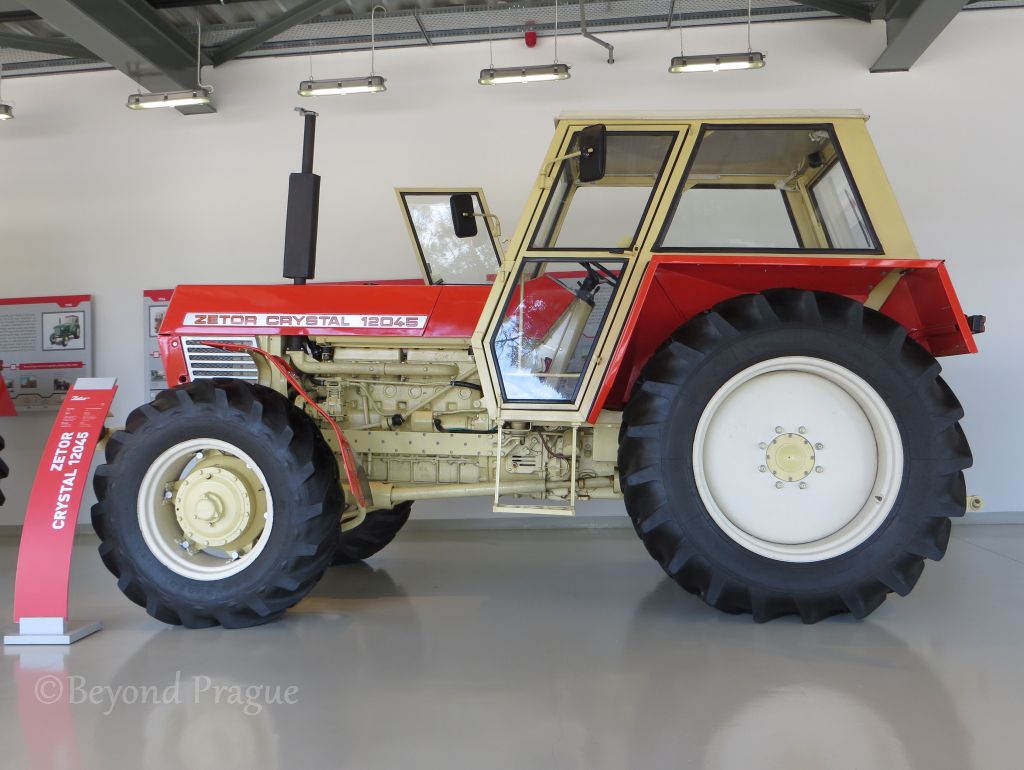
2026 is the 80th anniversary year of legendary Czech tractor company, Zetor!
Zetor started as the tractor building division of the Zbrojovka Brno company in 1945, but became its own company in 1946.
I’ve taken the opportunity to revisit my existing article about Zetor and make some improvements on it. I’ve removed some outdated sections and improved the flow of text as well as update the list of links.
I hope you enjoy the updated article as much as I enjoyed updating it:
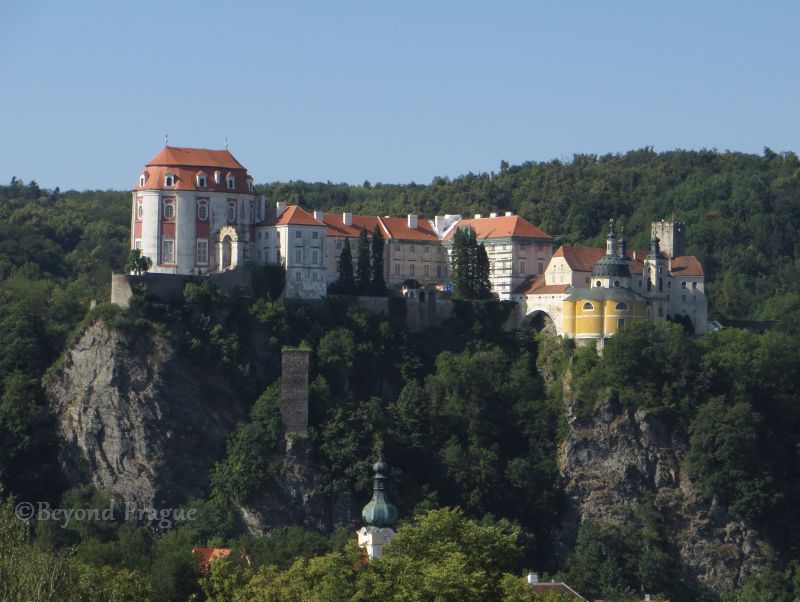
Vranov nad Dyjí is a small town in the South Moravian region that shares its name with the picturesque Baroque chateau perched on a rocky promontory approximately 80 metres (262 feet) above the townsite. The town lies along the Dyje River, roughly 3 kilometres (2 miles) from the Austrian border.
The Dyje River Valley is a protected natural region forming the heart of Podyjí National Park. The river itself constitutes part of the Czech–Austrian border and is known as the Thaya River on the Austrian side. Together with Thayatal National Park in Austria, Podyjí forms an international park that straddles the frontier and is popular with visitors from both countries.
The chateau and its surrounding parkland complement one another remarkably well, and both are exceptionally photogenic.
With that setting in mind, the story of Vranov Chateau unfolds:
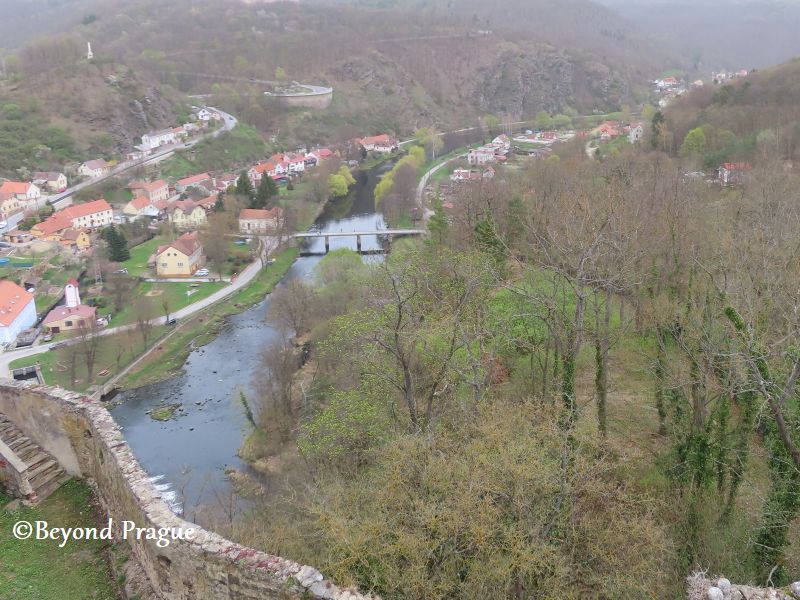
The Dyje river seen from the chateau. Remnants of the medieval walls are visible in the lower right corner.
Through Much History and Many Hands
The current chateau stands on the site of a medieval fortress that once formed part of a border defence system. The earliest written records of the fortress date to around 1100.
Over the centuries, the fortress passed through many hands. The most significant owners were arguably the Althann family, an ancient noble house of Bavarian origin. Their tenure at Vranov spans two distinct periods, encompassing both the original fortress and the later Baroque chateau.
Althann ownership began in 1617, when Wolf Dietrich von Althann (1576–1623) purchased the fortress. His tenure proved short-lived. In 1619, he participated in the Moravian Estates Rebellion, when Protestant landowners in Moravia rose against the Catholic rule of the Habsburg dynasty. This uprising formed part of the broader Bohemian Estates Rebellion, which began in 1618 and culminated in the Battle of White Mountain near Prague in December 1620.
The Catholic victory at White Mountain led to widespread confiscations of Protestant-owned estates, including the seizure of the fortress from the Althann family.
During the Thirty Years’ War (1618–1648), Swedish troops looted the town and damaged the fortress during an unsuccessful siege. A major fire in 1665 later gutted the structure, leaving it effectively in ruins.
The Althanns returned to Vranov in 1680, when Michael Johann II von Althann (1643–1702), a loyal supporter of the Habsburgs, purchased the remains of the fortress. He intended not merely to restore it, but to transform it into a residence befitting contemporary noble taste.
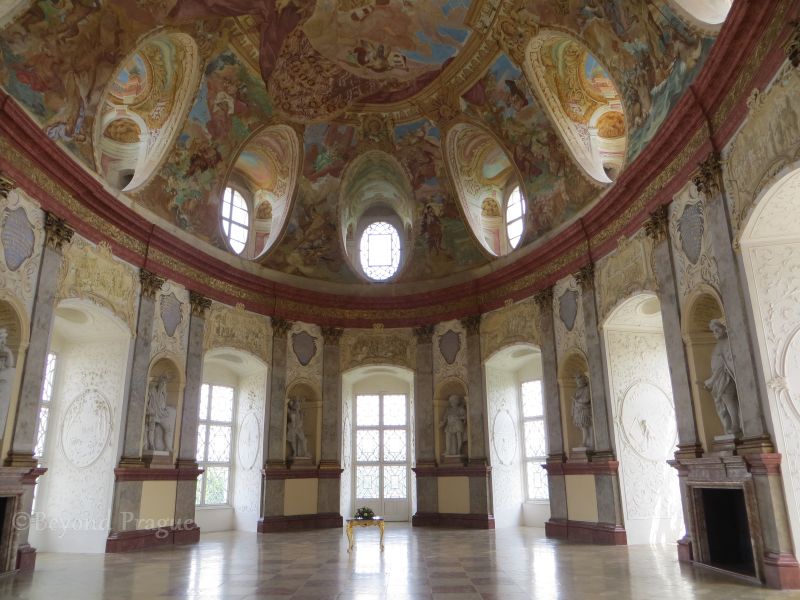
The Hall of Ancestors.
To realize this vision, he commissioned Johann Bernhard Fischer von Erlach (1656–1723), one of the most influential Austrian architects of the Baroque era. Fischer von Erlach played a central role in shaping Baroque architecture in the Habsburg lands, and his work at Vranov reflects that sophistication.
The heart of the Baroque reconstruction was the monumental Hall of Ancestors, begun in 1687. Built on an oval floor plan, the hall features sculptures of prominent members of the Althann family set within alcoves around the perimeter. Above, a grand cupola crowned with frescoes—completed over the course of eight years—dominates the space.
Fischer von Erlach also designed the chateau’s chapel and Althann family vault beneath it.
After Michael Johann II’s death in 1702, his heirs continued to develop the estate. As Baroque tastes gradually gave way to Classicism, elements of the newer style were introduced. The Althann chapter of Vranov’s history came to an end in the late eighteenth century, when financial difficulties led to the estate’s acquisition in 1793 through bankruptcy proceedings by Joseph Hilgartner of Lilienborn (1763–c.1811).
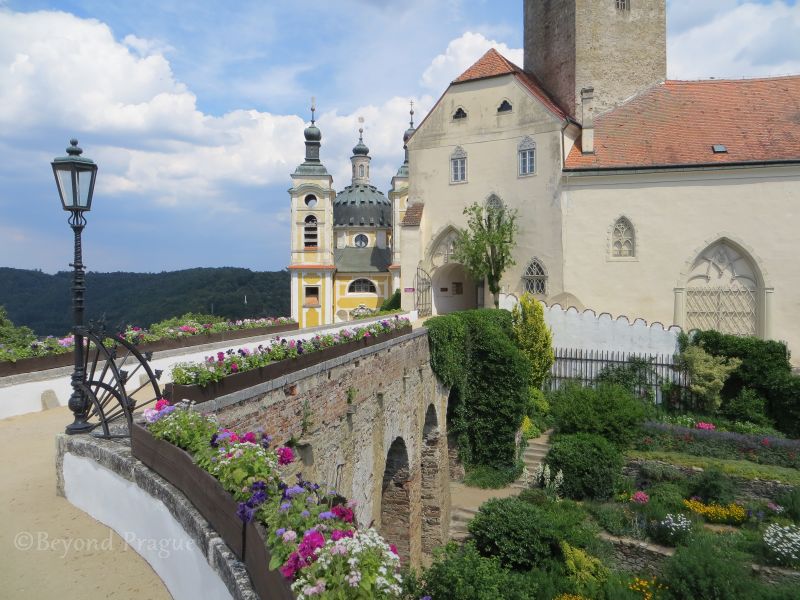
A view of the chateau with a portion of the gardens and the chapel visible.
Hilgartner built upon the foundations laid by the Althanns, focusing particularly on the gardens and parkland. His contributions included the addition of stables, a carriage house, and a summer hunting lodge.
His ownership was brief; in 1799 he sold the chateau and town to the Polish noble Mniszek family. In 1876, ownership passed to the related Stadnicki family. Under Polish stewardship, alterations to the chateau were largely decorative rather than structural.
The legacies of the Mniszek and Stadnicki families are perhaps cultural as much as architectural. Both were ardent patrons of literature and the arts, and their presence brought concerts and theatrical performances to the chateau, along with the creation of an extensive library.
The town itself prospered during the nineteenth century. In 1816, Stanisław Mniszek (1774–1846) purchased a small local pottery works and invested heavily in its expansion. The enterprise grew into a respected manufacturer of pottery and porcelain, earning a reputation at home and abroad.
Polish ownership ended abruptly in 1938 with the German annexation of Czechoslovakia. The chateau and its lands were confiscated from the Stadnicki family. Following the Second World War, properties owned by individuals of German nationality in Czechoslovakia were seized by the state, and Vranov Chateau remains in state ownership today.
Entrance hall
Take a Look Inside
While the exterior preserves its Baroque character, the interiors reveal the influence of Classicism most clearly.
Two guided tour options are available. The first, lasting approximately 45 minutes, includes the state rooms and the Hall of Ancestors and focuses primarily on the Althann period.
The state rooms provide an excellent introduction to the principles of Classicist design. In contrast to the excess of the Late Baroque, Classicism favoured restraint: cleaner lines, balanced proportions, and decoration inspired by the architecture of ancient Greece and Rome.
Like the Hall of Ancestors, the entrance hall is imposing in scale and crowned with a frescoed cupola. Illusionistic paintings of columns and classical motifs adorn the walls and lower portions of the dome. The furnishings are refined and luxurious without appearing excessive.
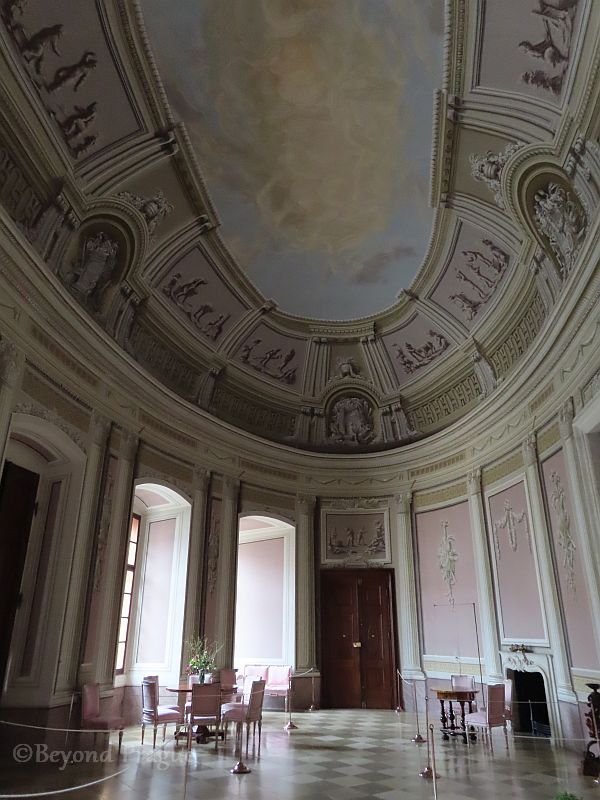
Other rooms on the basic tour that illustrate the spacious and orderly qualities of Classicism include the dining room and the drawing room. Both feature wall coverings in muted colours, restrained decorative detailing, stucco accents, and finely crafted wood mouldings at the tops and bottoms of the walls.
The second tour, lasting approximately 50 minutes, explores the private apartments and the chapel interiors, with emphasis on the Mniszek and Stadnicki eras.
Tours are conducted in Czech only; however, printed materials in other languages are available upon request to assist non-Czech speakers.
The drawing room
Paying a Visit and Learning More
Vranov nad Dyjí and the chateau are accessible by road. If travelling by bus from elsewhere in the Czech Republic, you will likely need to transfer in Znojmo. The bus from Znojmo stops at Vranov nad Dyjí, Zámecký hotel, where you can connect to another bus that continues to Vranov nad Dyjí, Zámek, adjacent to the chateau.
Visitors arriving by car should note that the main parking lot is located in the town approximately 800 metres (0.5 miles) downhill from the chateau. Limited bus service operates from the parking area to the Vranov nad Dyjí, Zámek stop. Alternatively, a walking path runs roughly parallel to the road, ascending through forested terrain to the chateau. The route is uphill, and suitable footwear, reasonable physical fitness, and tick-appropriate insect repellent are essential.
As part of Podyjí National Park, the surrounding area offers numerous hiking and cycling trails, some of which provide scenic approaches to the chateau.
Vranov’s appeal extends beyond the chateau itself. As part of a national park region rich in natural beauty and cultural heritage, the broader Vranovsko region offers much to explore for those willing to linger.
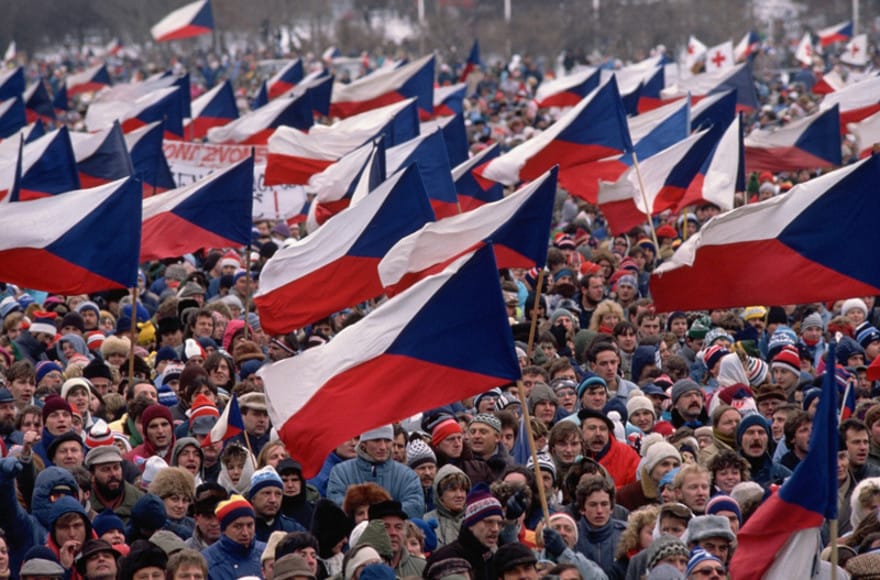
Velvet Revolution, Prague, 1989 — (photo: Peter Turnley, public domain)
Students and Solidarity
November 17 is a national holiday in the Czech Republic commemorating two student-led protests against tyranny. The first, in 1939, was a demonstration against the German occupation that followed the killing of a Czech student by German troops.
Fifty years later, on the same date in 1989, Czech students once again protested tyranny—this time against the Communist regime—sparking the Velvet Revolution. The date’s current national holiday status is more closely associated with the 1989 events.
November 17, 1939
On this day, the dormitories of Prague’s Charles University were stormed by Nazi forces following student-led protests against the German occupation of Czechoslovakia. Nine students identified as ringleaders were executed without trial.
More than 1,000 others who participated in the protests were sent to concentration camps, and all Czech universities and colleges were closed for three years.
A detailed account of those events can be found here:
Students in Czechoslovakia once again rose against oppression in 1989—this time against Communist rule. After decades of authoritarian control, the decline of the Eastern Bloc led to widespread unrest and demonstrations throughout Central and Eastern Europe. In Czechoslovakia, the November 1989 protests culminated in the fall of the Communist regime.
New political parties were formed and legalized, the Communist Party was stripped of its powers, and Václav Havel (1936–2011) was appointed president. Thousands of political prisoners were granted amnesty. These events became known as the Velvet Revolution.
For many Czechs, November 17 is simply a public holiday. However, those who wish to commemorate the day can attend various events in the week leading up to it, collectively known as Freedom Week. The largest celebrations take place on Prague’s Národní třída, a major site of the 1989 protests.
Freedom Week is organized by the non-profit group — Díky, Že Můžem(Thanks that we can). Their flagship event in Prague, Korzo Národní, offers a wide range of activities in both Czech and English.
Smaller Freedom Week events may also be found in other locations across the country.
A view into the Libenský Colonnade, one of the places you can access Poděbrady’s spring water.
Hearts and Bones
Poděbrady is a city of about 15,000 people located roughly 40 kilometres east of Prague. It sits on the Labe (Elbe) River and is one of the Czech Republic’s many spa towns.
The first mineral springs were discovered in 1905, and the first spa opened three years later, in 1908. From its founding, Poděbrady quickly built a reputation at home and abroad for high-quality spa treatments.
Most spa towns specialize in treating particular bodily systems. In the case of Poděbrady, those are the cardiovascular and musculoskeletal systems. The healing waters here are noted for their alkaline nature and high levels of carbon dioxide, sodium-calcium chloride, and iron. There are 12 public taps around town where you can freely sample the spring water. A bottled version, Poděbradka, is widely available for purchase across the country.
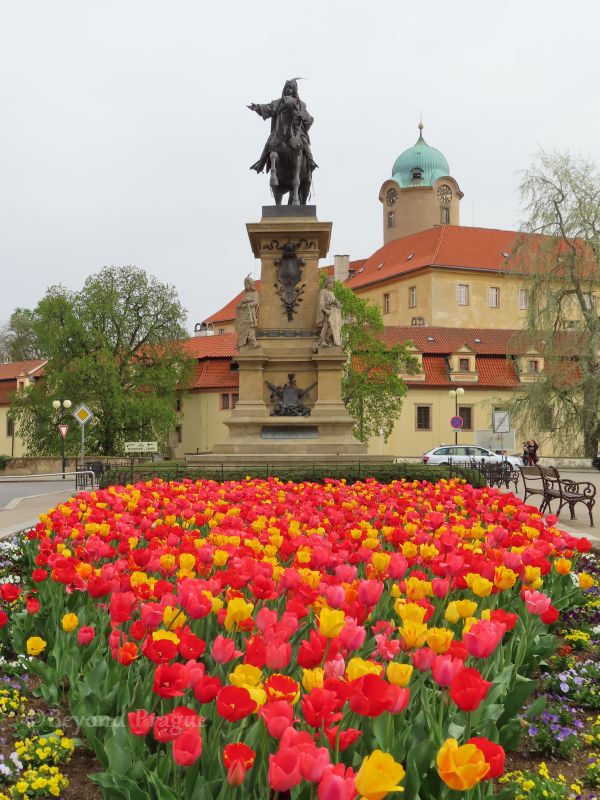
Statue of George of Poděbrady with the town castle behind.
Life Before the Spas
While the discovery of mineral springs and the establishment of spas gave Poděbrady prominence going into the 20th century, the town was well known long before that.
The first written mention of Poděbrady dates to 1223. It was a popular retreat for the Bohemian nobility thanks to its rich hunting grounds and proximity to Prague.
In the 1260s, Poděbrady became the property of King Otakar II of Bohemia after the previous owner died without heirs. Under Otakar II, the town’s castle was built.
The town remained under crown ownership until around 1350, when King Charles IV gifted it to the noble House of Kunštát. Around this time, the Poděbrady branch of that family line was established.
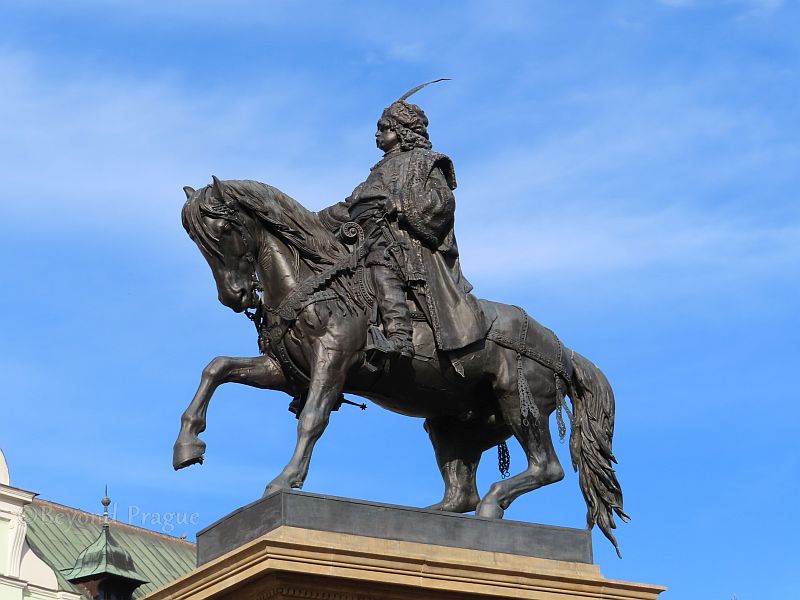
The most significant historical figure associated with the town, Jiří z Poděbrad (George of Poděbrady), was born here in 1420. He ruled as King of Bohemia from 1458 until his death in 1471. George was an outstanding diplomat and the first ruler to attempt to create a peaceful union among Europe’s monarchs. Although his plan did not succeed, it foreshadowed later efforts to unite Europe—culminating centuries later in the creation of the European Union in 1993.
George ruled at a time when Bohemia was religiously divided between the Hussite movement and the Catholic Church. Though he was a Hussite, he is remembered as a moderate and tolerant ruler who encouraged peace between the two sides. This earned him the nickname “King of Two Peoples.”
Another angle on the George of Poděbrady statue.
The town was elevated to city status near the end of George’s reign and continued to flourish under subsequent rulers until the 17th century, when the Thirty Years’ War brought devastation as Swedish and Saxon armies invaded the area.
Poděbrady’s appearance changed significantly after a major fire in 1681. Many wooden buildings, including the town hall, were destroyed and replaced with brick structures. Around the same time, the city walls were demolished and the moats filled in.
Empress Maria Theresa Habsburg visited Poděbrady several times during her reign. Between 1752 and 1757, she ordered the castle to be renovated to accommodate herself, her husband, and their entourage.
When Maria Theresa’s eldest son, Joseph II, inherited power, he converted the castle into a residence for retired officers of the imperial army.
The city experienced a brief downturn after fires in 1800 and 1832. The Poděbrady estate was later purchased, in 1840, by Austrian-Greek businessman and banker Georgios Sinas (1783–1856), under whom the city began to prosper again.
Sinas’s great-granddaughter, Princess Charicléa of Hohenlohe-Schillingfürst (née Ypsilanti), took up residence in the castle in 1885 with her husband. Their legacy was one of charity and compassion for the poor. The princess established a local fund for those in need, often used the castle kitchen to prepare meals for them, and founded an orphanage in the city. The couple owned the castle until the princess’s death in 1912, and they were its last private owners.
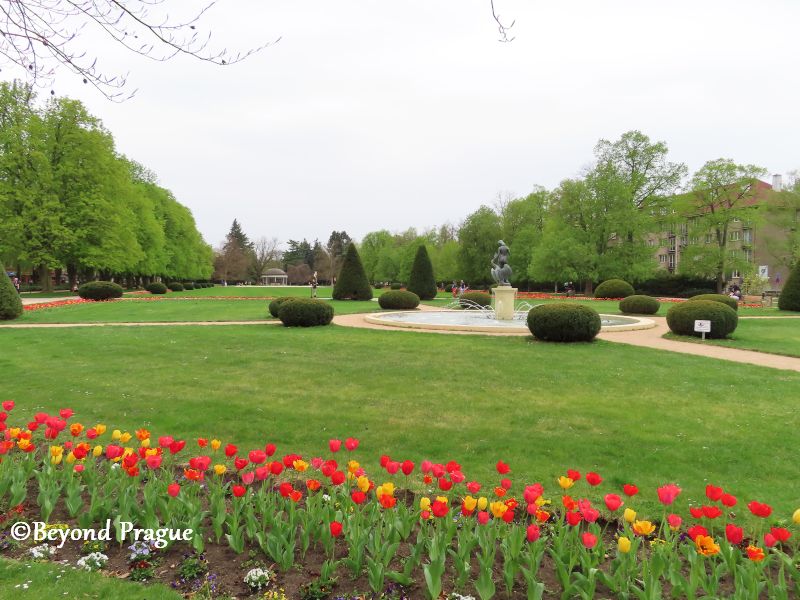
Looking across T. G. Masaryk Square to Lázeňský Park and Libenský Colonnade
A Feel for the Place
As one might expect of a spa town, Poděbrady feels relaxed and unhurried. While it has a basic public transport system, it’s a city best explored on foot.
If you arrive by rail, the first attraction you’ll see is T. G. Masaryk Square, located directly across from the train station. The square connects to Lázeňský Park, forming a lovely green corridor between the station and the city centre. At the junction of the square and park, you’ll find the eye-catching Libenský Colonnade, one of several spots where you can sample the mineral spring water.
This is just one example of the abundance of green space in Poděbrady. The city offers several other parks, as well as walking and cycling trails along both banks of the river.
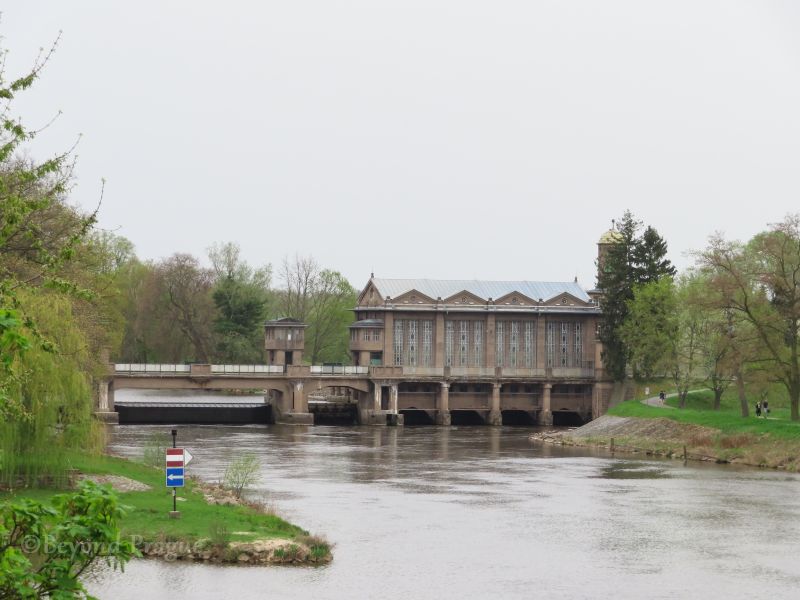
The historic hydroelectric power station
The area around the Labe is particularly pleasant, with pedestrian walkways on each side. While strolling along the river, you’ll also come across the historically important hydroelectric power station, built between 1914 and 1919 and still in operation today.
The power station, built in the Neoclassical style, has been listed as a national cultural monument since 2012 and is protected as part of the Czech Republic’s industrial heritage.
A walk along the city side of the riverbank will take you past a number of small pubs and cafés, as well as the dock for a riverboat that cruises between Poděbrady and Nymburk, the main city in the region.
The opposite bank offers scenic views of the castle, along with access to natural areas and a nearby lake.
View of the castle from across the river.
To the Castle
Poděbrady Castle dates to the reign of King Otakar II in the late 13th century, when he ordered a stone water fortress to replace the wooden structure that had previously stood on the site.
In its early days, the fortress defended Prague from attacks coming from the east and northeast and controlled a strategically important crossing on the Labe River. During the Hussite Wars (1419–1434), the castle was unsuccessfully besieged in 1420 and again in 1426.
Like many Czech castles, Poděbrady’s evolved over the centuries from a practical fortification into a residence for the nobility.
Emperor Ferdinand I (1503–1564) ordered the castle to be rebuilt in the comfortable Renaissance style as a hunting lodge. It was damaged during the Thirty Years’ War (1618–1648) and declined in importance thereafter.
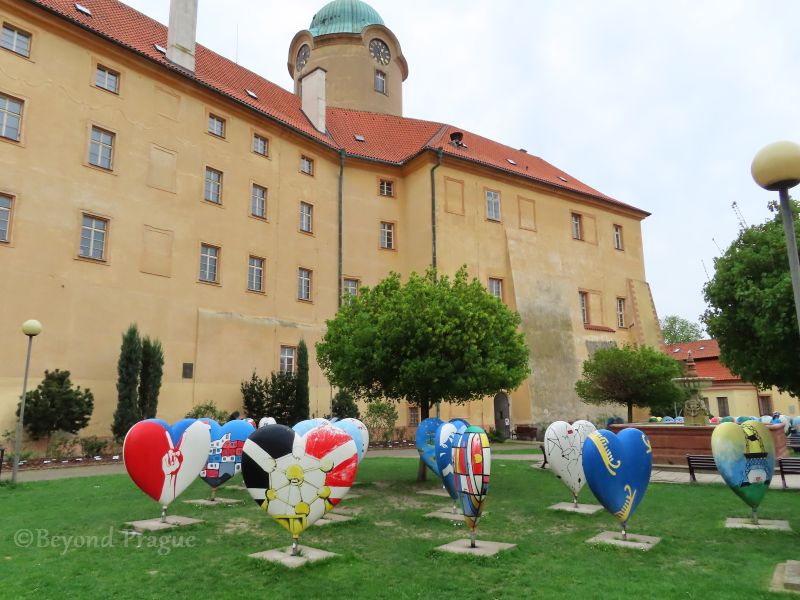
Heart themed art installation in the castle courtyard.
As noted earlier, Maria Theresa Habsburg later ordered another reconstruction, this time in Baroque style—a face the castle retains today.
Despite these transformations, the castle still presents a massive, formidable silhouette along the river.
Guided tours are available, including one dedicated to the legacy of George of Poděbrady, who was very likely born within its walls. During opening hours, visitors can freely enter the castle courtyard, where a permanent art installation features several heart sculptures, each decorated with motifs representing a nation of the European Union. The installation commemorates George’s early vision of European unity and celebrates the city’s long-standing connection to heart health.
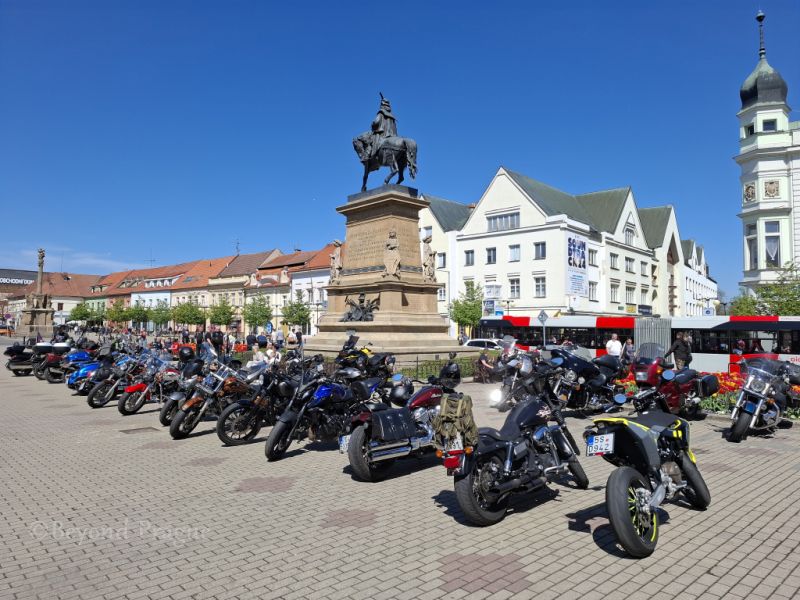
Motorcycles on the square, something to be aware of in the spring and summer months.
Paying a Visit and Learning More
Poděbrady is easy to reach—it’s a stop on several train lines. The city’s main tourist information office is conveniently located in the train station, making it a good first stop for visitors arriving by rail.
The city offers a range of dining and accommodation options to suit most travellers. It’s large enough for a weekend getaway but compact enough for an easy day trip.
If you visit in spring or summer, be aware that Poděbrady is a popular lunch-hour gathering spot for motorcyclists on cross-country rides. They usually congregate on George’s Square (Jiřího náměstí).
If you enjoy motorcycles, you’ll appreciate the friendly atmosphere and the chance to see some fascinating machines. The downside is that the crowds can be noisy, and service at restaurants around the square may slow considerably.
To avoid the bustle, consider dining at one of the restaurants near T. G. MasarykSquare, Lázeňský Park, or along the city-side riverbank.
To learn more, visit Poděbrady’s official website, which is multilingual in Czech, English, French, German, and Russian.
On September 21 of 2025, I had the good fortune of sharing a bus ride with Simon Calder, travel correspondent for Independent Travel, while travelling from Ostrava to Brno.
We parted ways when the bus arrived in Brno, but arranged to meet in the evening. We had some beers and food and recorded this installment of his podcast for The Independent.
Czechs have a rich history in aviation that dates back almost to the dawn of powered flight. Jan Kašpar (1883–1927) was one of the Czech pioneers of aviation and is widely recognized as the first Czech to fly.
Kašpar was born into a wealthy family in Pardubice. His family owned the Hotel Veselka, a well-known local establishment that served as a social hub in the city prior to the Second World War. Ownership of the hotel changed hands in the early 1920s. During the Second World War, the building became an operational centre for the Czech resistance.
German forces eventually seized the building and repurposed it. After the war, it was converted into an office block. Ultimately, it was demolished in the early 1970s due to extensive structural degradation.
Jan Kašpar had little interest in the hotel business. He enjoyed many sports and developed a keen interest in technology from an early age. He trained as a mechanical engineer at the Czech Technical University in Prague and later continued his studies in Germany, specializing in aircraft engine design.
After returning from Germany, Kašpar worked for Laurin & Klement—the predecessor of Škoda Auto. He left this position to pursue his passion for aviation and his dream of building his own aircraft.
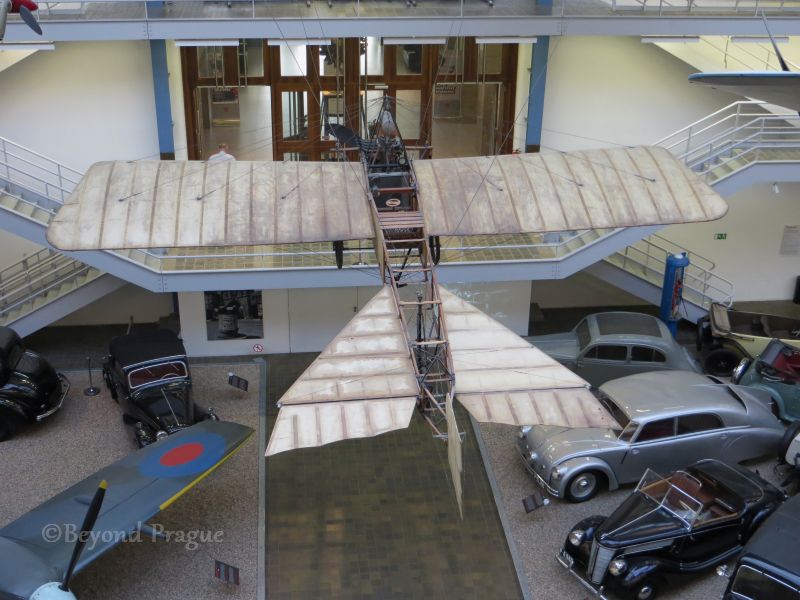
Kašpar’s JK Blériot XI on display at the National Technical Museum in Prague.
A False Start and a French Connection
By 1909, Kašpar had constructed his first aircraft. Due largely to his inexperience as a pilot and the aircraft’s under-powered engine, he was unable to get it airborne.
1909 was also the year that Louis Blériot made his historic flight across the English Channel. Upon hearing of Blériot’s achievement, Kašpar travelled to France and purchased a Blériot XI—similar to the one Blériot had used.
On April 16, 1910, Kašpar took off in his Blériot XI, becoming the first Czech to fly an airplane. However, he aspired to achieve more.
On May 13, 1911, Kašpar flew from Pardubice to the Velká Chuchle district of Prague. The flight lasted 92 minutes and covered 121 kilometres. It was the first long-distance flight not only over Czech territory but also within the Austro-Hungarian Empire. This achievement made Kašpar a household name and captured the imagination of the public.
On July 12, 1911, he flew the same aircraft to Kroměříž, landing to the applause of 15,000 spectators who had paid to witness the event.
The aircraft he used for these flights was a modified version of the Blériot XI that he had built himself. Powered by a Daimler four-cylinder engine, he named it the JK Blériot XI—including his initials to distinguish it from the factory-standard model.
In 1913, Kašpar donated the JK Blériot XI to the National Technical Museum in Prague. Today, it is displayed prominently in the museum’s transportation collection.
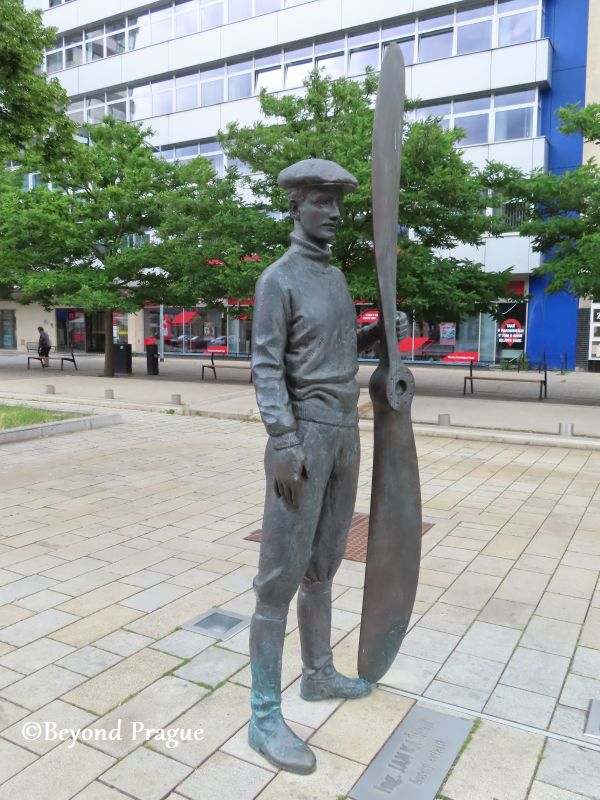
Jan Kašpar’s statue in Pardubice.
War and Decline
Despite the fame brought by his flights, Kašpar’s flying career was brief. His last public flight occurred in July 1912.
In 1913, following the death of his father—a strong supporter of his aviation work—Kašpar was forced to abandon flying to manage the family estate. His father’s passing affected him deeply.
During the First World War, he worked as an aircraft technician and later briefly served in the Ministry of Public Works.
Kašpar’s later years were marked by hardship. He struggled with both the family business and a timber trading enterprise he launched after the war. Financial ruin and physical and mental health issues plagued him.
He died in hospital on March 2, 1927. The exact circumstances of his death remain a topic of debate.
Hospital records indicate that he died of pneumonia, possibly linked to long-term exposure to engine exhaust. This is plausible given his involvement in motorsport prior to his flying career.
Other sources suggest that he took his own life. According to some of these accounts, he was taken to the hospital after his sister found him unconscious with his flying scarf soaked with gasoline nearby. Given his dire financial and personal circumstances, this theory is also plausible.
The truth likely lies somewhere in between.
Regardless, Kašpar received a full religious funeral—a rite that would not have been granted had suicide been the official cause of death. He is buried in Pardubice Central Cemetery.
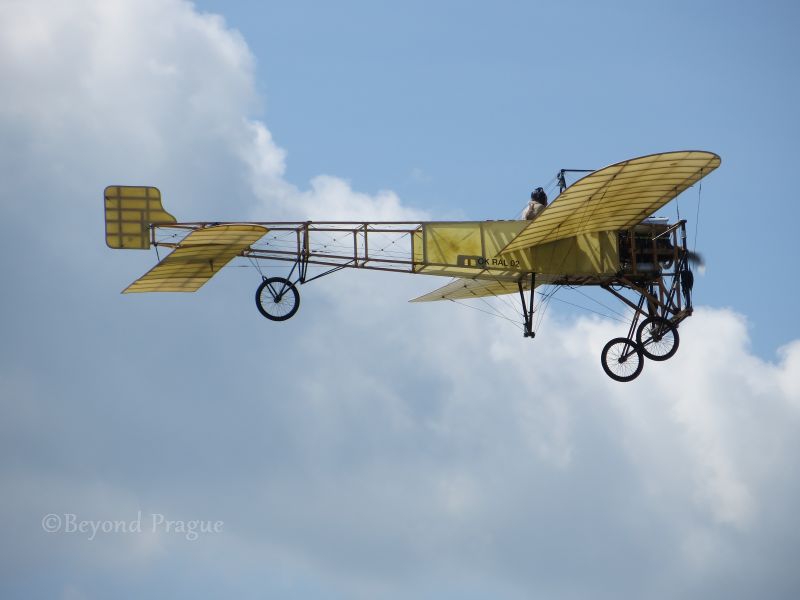
A replica Blériot XI performing at the annual Aviatická Pouť airshow in Pardubice.
Jan Kašpar’s Legacy
Jan Kašpar is widely regarded as the father of Czech aviation, and Pardubice is often referred to as its cradle.
He is considered a hometown hero in Pardubice. A statue commemorating him stands near the former site of Hotel Veselka. The city’s airport terminal bears his name, and a small aviation museum also honours him. As of 2025, the museum is temporarily closed pending relocation to the Kunětice airport near Pardubice.
Each year, the city hosts an air show called Aviatická Pouť, typically held in late May or early June to coincide with the anniversary of Kašpar’s 1911 flight from Pardubice to Prague.
Nationally, his legacy is evident in the aviation enthusiasm his early achievements inspired, laying the foundation for the country’s rich aviation heritage.
Another view of the JK Blériot XI on display at the National Technical Museum in Prague.
Further Reading
Information about Jan Kašpar is limited outside the Czech language, and many available sources contain conflicting or inaccurate details.
The following articles are all reasonably reliable and respond well to online translators:






 Beyond Prague