A Bastion in the Valley
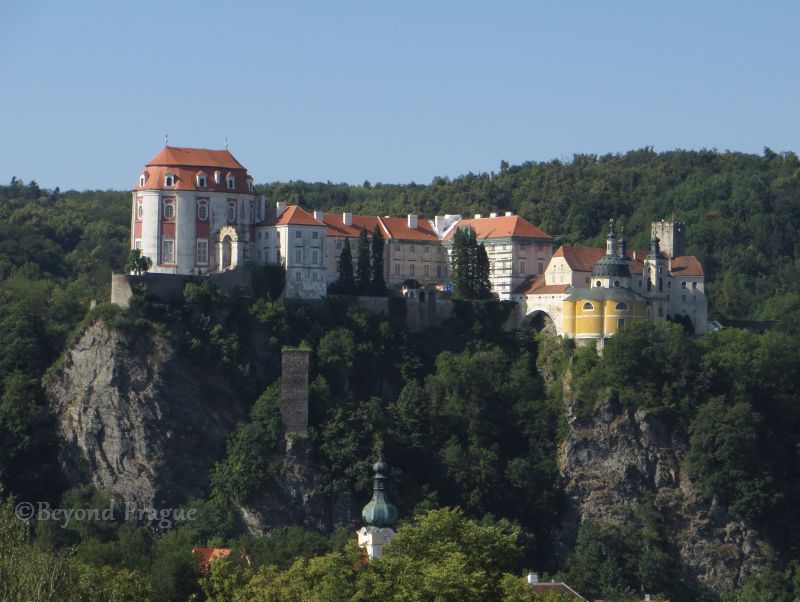
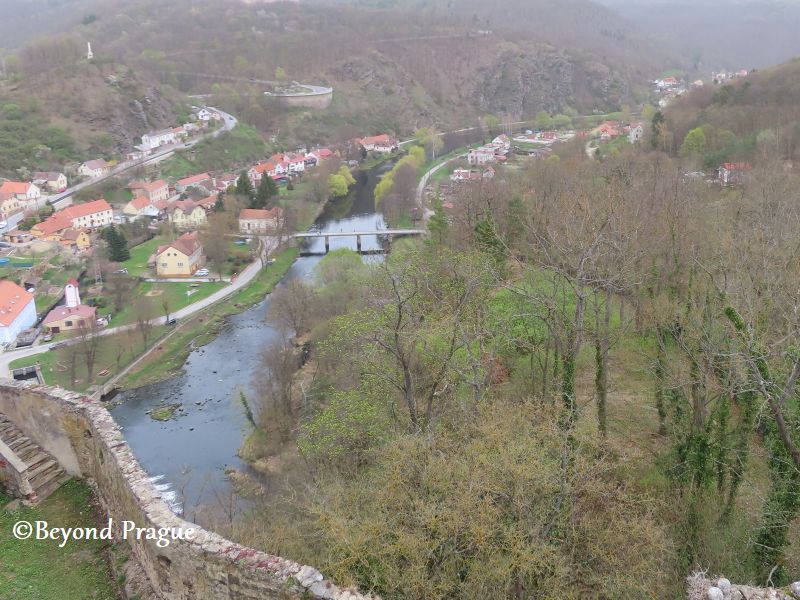
Vranov nad Dyjí is a small town in the South Moravian region that shares its name with the picturesque Baroque chateau perched on a rocky promontory approximately 80 metres (262 feet) above the townsite. The town lies along the Dyje River, roughly 3 kilometres (2 miles) from the Austrian border.
The Dyje River Valley is a protected natural region forming the heart of Podyjí National Park. The river itself constitutes part of the Czech–Austrian border and is known as the Thaya River on the Austrian side. Together with Thayatal National Park in Austria, Podyjí forms an international park that straddles the frontier and is popular with visitors from both countries.
The chateau and its surrounding parkland complement one another remarkably well, and both are exceptionally photogenic.
With that setting in mind, the story of Vranov Chateau unfolds:
Through Much History and Many Hands
The current chateau stands on the site of a medieval fortress that once formed part of a border defence system. The earliest written records of the fortress date to around 1100.
Over the centuries, the fortress passed through many hands. The most significant owners were arguably the Althann family, an ancient noble house of Bavarian origin. Their tenure at Vranov spans two distinct periods, encompassing both the original fortress and the later Baroque chateau.
Althann ownership began in 1617, when Wolf Dietrich von Althann (1576–1623) purchased the fortress. His tenure proved short-lived. In 1619, he participated in the Moravian Estates Rebellion, when Protestant landowners in Moravia rose against the Catholic rule of the Habsburg dynasty. This uprising formed part of the broader Bohemian Estates Rebellion, which began in 1618 and culminated in the Battle of White Mountain near Prague in December 1620.
The Catholic victory at White Mountain led to widespread confiscations of Protestant-owned estates, including the seizure of the fortress from the Althann family.
During the Thirty Years’ War (1618–1648), Swedish troops looted the town and damaged the fortress during an unsuccessful siege. A major fire in 1665 later gutted the structure, leaving it effectively in ruins.
The Althanns returned to Vranov in 1680, when Michael Johann II von Althann (1643–1702), a loyal supporter of the Habsburgs, purchased the remains of the fortress. He intended not merely to restore it, but to transform it into a residence befitting contemporary noble taste.
To realize this vision, he commissioned Johann Bernhard Fischer von Erlach (1656–1723), one of the most influential Austrian architects of the Baroque era. Fischer von Erlach played a central role in shaping Baroque architecture in the Habsburg lands, and his work at Vranov reflects that sophistication.
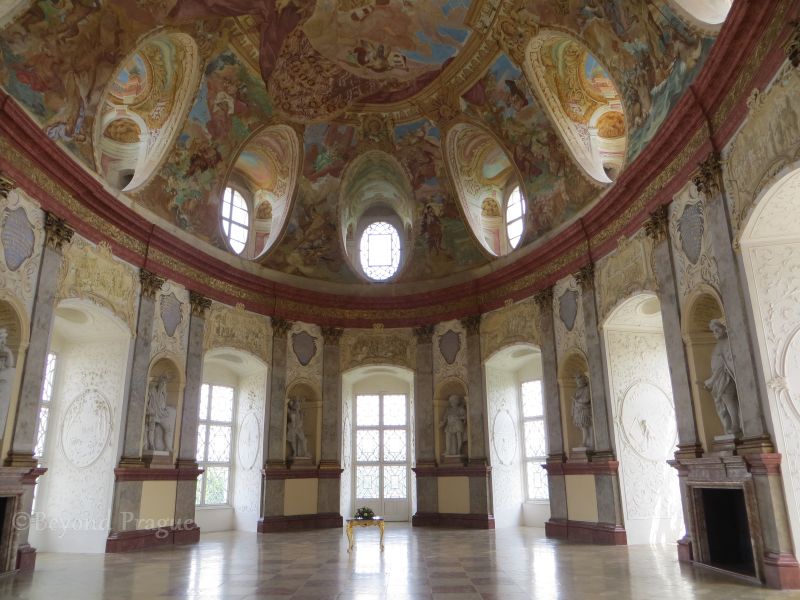
The heart of the Baroque reconstruction was the monumental Hall of Ancestors, begun in 1687. Built on an oval floor plan, the hall features sculptures of prominent members of the Althann family set within alcoves around the perimeter. Above, a grand cupola crowned with frescoes—completed over the course of eight years—dominates the space.
Fischer von Erlach also designed the chateau’s chapel and Althann family vault beneath it.
After Michael Johann II’s death in 1702, his heirs continued to develop the estate. As Baroque tastes gradually gave way to Classicism, elements of the newer style were introduced. The Althann chapter of Vranov’s history came to an end in the late eighteenth century, when financial difficulties led to the estate’s acquisition in 1793 through bankruptcy proceedings by Joseph Hilgartner of Lilienborn (1763–c.1811).
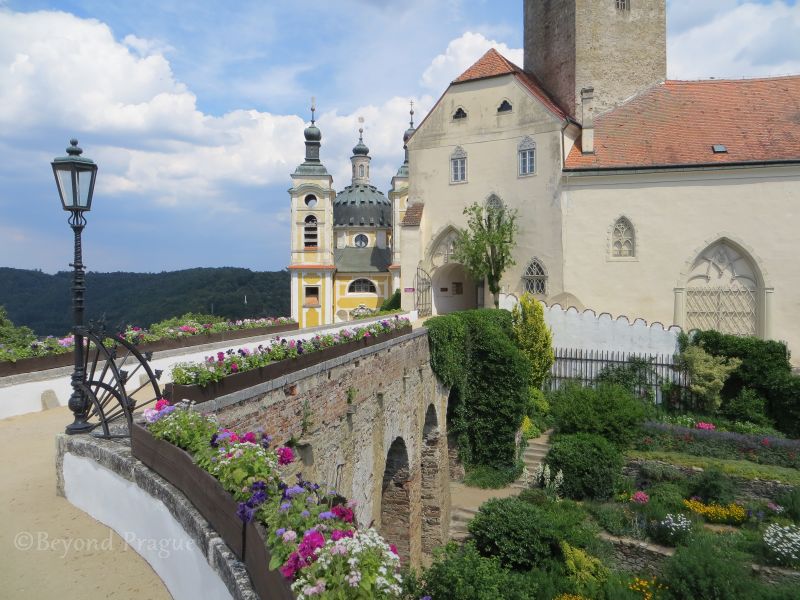
Hilgartner built upon the foundations laid by the Althanns, focusing particularly on the gardens and parkland. His contributions included the addition of stables, a carriage house, and a summer hunting lodge.
His ownership was brief; in 1799 he sold the chateau and town to the Polish noble Mniszek family. In 1876, ownership passed to the related Stadnicki family. Under Polish stewardship, alterations to the chateau were largely decorative rather than structural.
The legacies of the Mniszek and Stadnicki families are perhaps cultural as much as architectural. Both were ardent patrons of literature and the arts, and their presence brought concerts and theatrical performances to the chateau, along with the creation of an extensive library.
The town itself prospered during the nineteenth century. In 1816, Stanisław Mniszek (1774–1846) purchased a small local pottery works and invested heavily in its expansion. The enterprise grew into a respected manufacturer of pottery and porcelain, earning a reputation at home and abroad.
Polish ownership ended abruptly in 1938 with the German annexation of Czechoslovakia. The chateau and its lands were confiscated from the Stadnicki family. Following the Second World War, properties owned by individuals of German nationality in Czechoslovakia were seized by the state, and Vranov Chateau remains in state ownership today.
Take a Look Inside
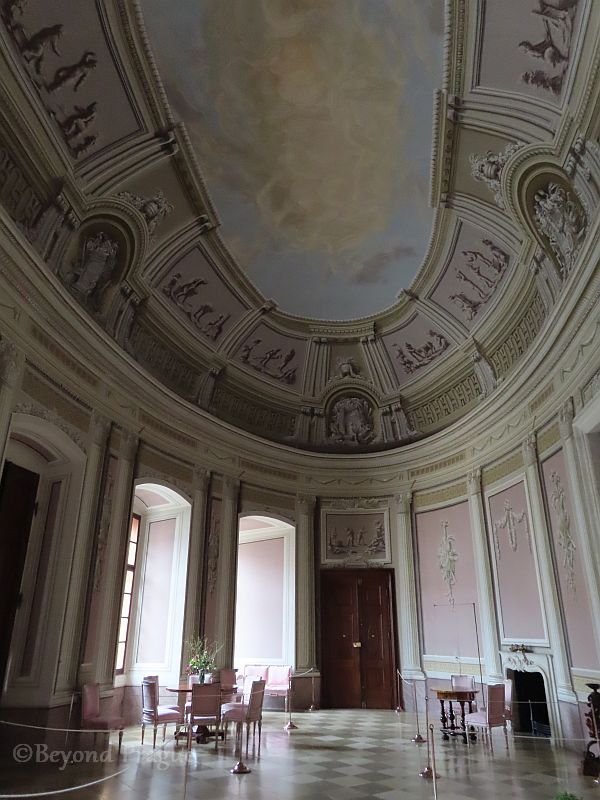
While the exterior preserves its Baroque character, the interiors reveal the influence of Classicism most clearly.
Two guided tour options are available. The first, lasting approximately 45 minutes, includes the state rooms and the Hall of Ancestors and focuses primarily on the Althann period.
The state rooms provide an excellent introduction to the principles of Classicist design. In contrast to the excess of the Late Baroque, Classicism favoured restraint: cleaner lines, balanced proportions, and decoration inspired by the architecture of ancient Greece and Rome.
Like the Hall of Ancestors, the entrance hall is imposing in scale and crowned with a frescoed cupola. Illusionistic paintings of columns and classical motifs adorn the walls and lower portions of the dome. The furnishings are refined and luxurious without appearing excessive.
Other rooms on the basic tour that illustrate the spacious and orderly qualities of Classicism include the dining room and the drawing room. Both feature wall coverings in muted colours, restrained decorative detailing, stucco accents, and finely crafted wood mouldings at the tops and bottoms of the walls.
The second tour, lasting approximately 50 minutes, explores the private apartments and the chapel interiors, with emphasis on the Mniszek and Stadnicki eras.
Tours are conducted in Czech only; however, printed materials in other languages are available upon request to assist non-Czech speakers.

Paying a Visit and Learning More
Vranov nad Dyjí and the chateau are accessible by road. If travelling by bus from elsewhere in the Czech Republic, you will likely need to transfer in Znojmo. The bus from Znojmo stops at Vranov nad Dyjí, Zámecký hotel, where you can connect to another bus that continues to Vranov nad Dyjí, Zámek, adjacent to the chateau.
Visitors arriving by car should note that the main parking lot is located in the town approximately 800 metres (0.5 miles) downhill from the chateau. Limited bus service operates from the parking area to the Vranov nad Dyjí, Zámek stop. Alternatively, a walking path runs roughly parallel to the road, ascending through forested terrain to the chateau. The route is uphill, and suitable footwear, reasonable physical fitness, and tick-appropriate insect repellent are essential.
As part of Podyjí National Park, the surrounding area offers numerous hiking and cycling trails, some of which provide scenic approaches to the chateau.
For current information on opening hours and admission fees, the chateau’s official website is the best starting point.
Vranov’s appeal extends beyond the chateau itself. As part of a national park region rich in natural beauty and cultural heritage, the broader Vranovsko region offers much to explore for those willing to linger.
 Beyond Prague