
Iconic Wheels
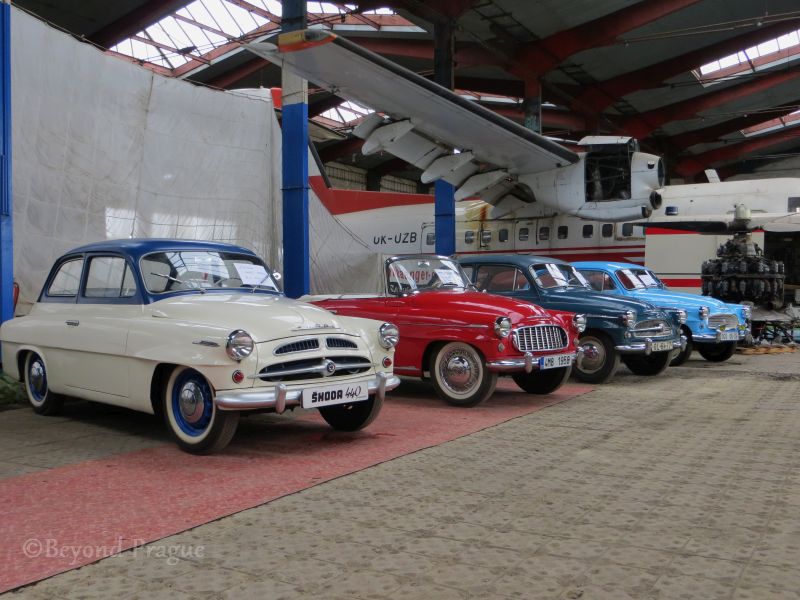
When one thinks of Czech brands, few are as synonymous with the former Czechoslovakia and modern Czech Republic on the global stage as Škoda.
For most people around the world, the Škoda name is most closely connected to automobiles. However, the Škoda company has a very long and complex history that stretches back much further than when the Škoda trademark first appeared on automobiles in the 1920s
The history of Škoda began with the foundation of the Škoda Works, in Plzeň, in 1859. Taking its name from its founder, Emil Škoda (1839 – 1900), the company was a diversified engineering firm that produced heavy guns for the Austro-Hungarian army and navy as well as locomotives and public transportation vehicles.
Škoda Auto was born in 1925, when Škoda branched into auto manufacture with the purchase of the the Laurin & Klement auto company that was based in Mladá Boleslav.
Laurin & Klement was established in 1895. The combined history of Laurin & Klement and Škoda Auto makes Škoda Auto one of the world’s oldest still operating auto manufacturers.
In spite of being a subsidiary of the Volkswagen Group since the early 1990s, the Škoda Auto name has remained inextricably linked to the Czech lands and people. It truly is a Czech heritage brand. Not only is Škoda Auto one of the oldest car manufacturers in the world, it is the oldest of the brands in the Volkswagen Group.
Let’s spend some time with Škoda Auto:

Laurin & Klement
Václav Laurin (1865-1930) and Václav Klement (1868-1938) founded the company that bore their names in Mladá Boleslav in 1895. With Laurin providing the engineering expertise and Klement the business accumen, the partnership was a well balanced one.
The company was established to design and build bicycles, but it soon moved into motorcycles and moved into car and truck manufacture in 1905.
Laurin & Klement built a reputation for vehicles of high quality and reliability. They also attracted a patron of noble heritage in Count Alexander “Sascha” Joseph Kolowrat-Krakowský (1886-1927).
Kolowrat is most famous for being a pioneer of the Austrian film industry, he established the first major film studio in the Austro-Hungarian Empire in 1910. Outside of his film work, his greatest passion was as a motorist and racer.
Kolowrat began racing motorcycles under the Laurin & Klement banner in 1904 and eventually moved into car racing, staying with the brand.
With the outbreak of the First World War, Laurin & Klement were forced to reduce personal automobile production and diversify their factory output into ammunition and other products required by the military.
The financial realities of the redivided Europe that appeared after the war made it very difficult for Laurin & Klement to resume production of personal automobiles. Partly this was because in the immediate post-war economy, personal automobiles were seen as a needless luxury.

While the company saw some success in the years immediately following the war through production of Excelsior brand motor ploughs, another obstacle to the company getting back to its old business was that its pre-war business model of small production runs was not going to work in the post-war economy as it translated into higher prices for the finished cars.
Rival car manufactures at the national level, Praga and Tatra, were mass producing smaller cars that were cheaper to purchase and operate. What Laurin & Klement were trying to produce, according to their pre-war business model, simply could not compete with the likes of the Praga Piccolo and Tatra 11.
From 1920, Alexander Kolowrat provided financial support to the company and set about trying to find a partner to help get the company back on its feet.
A combination of Kolowrat not being able to find a partner and a fire in 1924 that partially destroyed the factory, resulted in Laurin & Klement merging with Škoda Works in 1925. The merger saw the production of personal automobiles kept in Mladá Boleslav while the production of larger commercial vehicles was moved to Plzeň and overseen by a separate business concern also operating under the Škoda banner.
Following the merger, the factory in Mladá Boleslav got a modern production line. For a short period following the merger, automobiles constructed on the new production line carried both Škoda and Laurin & Klement badging. By 1926, only the iconic Škoda winged arrow emblem and name was carried.

The Škoda Shift
With the coming of the Great Depression in the 1930s, the takeover by Škoda could not have been more timely. Indeed, the takeover surely saved the jobs of many Laurin & Klement employees in that tumultuous decade.
From the 1925 takeover to 1935, Škoda enlarged and modernised the automotive assembly line in Mladá Boleslav. An output of 85 completed vehicles per day was achieved by the mid 1930s.
In the same period of time, Škoda introduced a new backbone chassis design to their cars to replace the older style ladder design chassis.
The backbone chassis design was pioneered by the Tatra company in the 1920s. It used less materials, which translated into manufacturing time and weight savings, and allowed for fully independant suspension for a smoother ride.
Through the 1930s, Škoda introduced four families of cars based on the backbone chassis: Popular, Rapid, Favorit and Superb.
Of the four new car families, the Popular could be considered the most significant to making Škoda a true player among Czech auto manufacturers. While the Rapid and Favorite were mid-sized designs and the Superb was a full-size luxury car, the Popular was built for the small-sized family car market and it gave Škoda an inexpensive design that could compete with the offerings of Praga and Tatra in that market segment.

Living up to its name, the Popular was very popular. It not only satisfied many in the personal automobile market, it also found favour in military and police services.
In the Sport optimised version, the Popular also kept the company firmly on the motorsport map during the 1930s.
The Popular Sport placed second in the 1500 cc class of the 1936 edition of the prestigious Monte Carlo Rally. This result in the rally sparked much public interest in the Popular as a sports car and inspired Škoda to create the Popular Monte Carlo version for public purchase in 1936.
Beyond the standard and sport versions, the Popular also served as the basis for commercial van, ambulance and light truck designs.
Development and production of the Popular, Rapid, Favorit and Superb ceased before the 1940s were out. However, it would not be the end of those names in the Škoda catalog. With those four car families, the company started a tradition of reviving and reusing model names on later designs. While Popular has never been reused, the other three model names have all been seen on later Škoda types at least once.

Another significant Škoda vehicle from the 1930s was the Dynamic.
The Dynamic was a singular prototype created to explore aerodynamics in car design.
Tatra introduced aerodynamics to car design in the early 1930s and had proven the value of designing the body shell of a car to reduce air resistance to improve fuel efficiency among other things. It only made sense for other manufacturers, like Škoda, to follow suit.
The results of the research carried out with the Dynamic were seen in the 1937 “Monte Carlo” versions of the Popular and Rapid as well as the 1940 versions of the Rapid.
A scaled down and lightened version of the Dynamic was built with the aim of entering it into the Monte Carlo Rally. However, with the German occupation of Czechoslovakia in 1939, all further work of sports vehicles was halted.
The Dynamic prototype was sold to a private owner in 1939. In the 1960s, when Škoda started building a collection of their historic vehicles, they purchased it back from the same private owner. Today, it holds a place of prominence in the Škoda Museum in Mladá Boleslav.
Occupation and Nationalisation
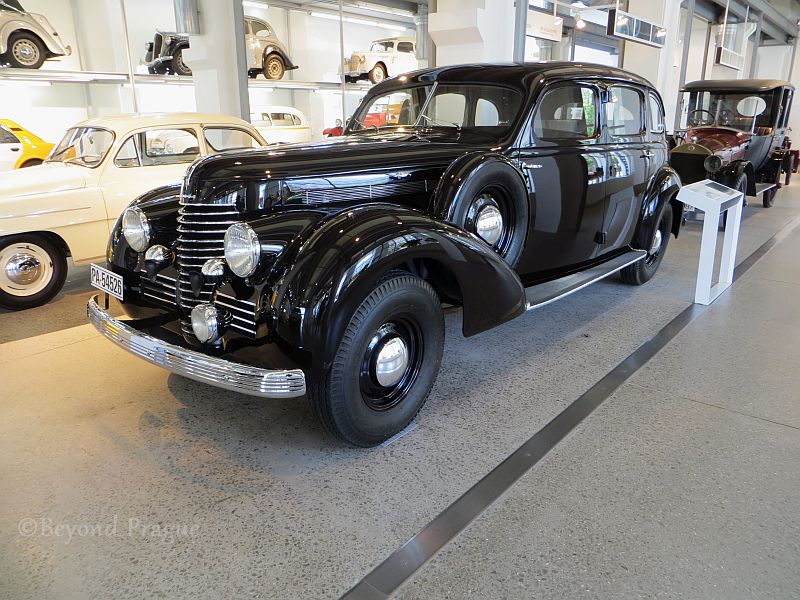
As it was with all Czech companies in the Second World War, Škoda Auto found themselves forced into supplying the German war effort.
The production of passenger cars was drastically reduced in favour of making components for German vehicles and aircraft as well as armaments.
Any vehicles which were produced were those of military interest. Supply wagons and heavy tractors constituted the bulk of the company’s wartime vehicle output.
The company also produced specialised military versions of their model 650 limosine and the Superb. Primarily, these versions were used as staff cars for high ranking German officers. The military version of the Superb was also modified for use as a personnel carrier and an ambulance.
The German occupiers were not the only thing Škoda Auto factory workers had to fear. The importance of the factory to the German war effort made it a target for Allied bombers during the conflict. In late April of 1945, a final attack was made against the factory. The factory was all but destroyed in the attack.
In spite of the war damage, the Mladá Boleslav factory was rebuilt by July of 1945 and first modernised models of the Popular were being built not long after.

In 1946, Škoda introduced the model 1101. The new model was a development of the modernised Popular. The model 1102, a slightly modified version of the 1101, was introduced in 1949.
Together, the 1101 and 1102 constituded the Tudor family in the company catalog. The Tudor would see the company through the late 1940s to the early 1950s.
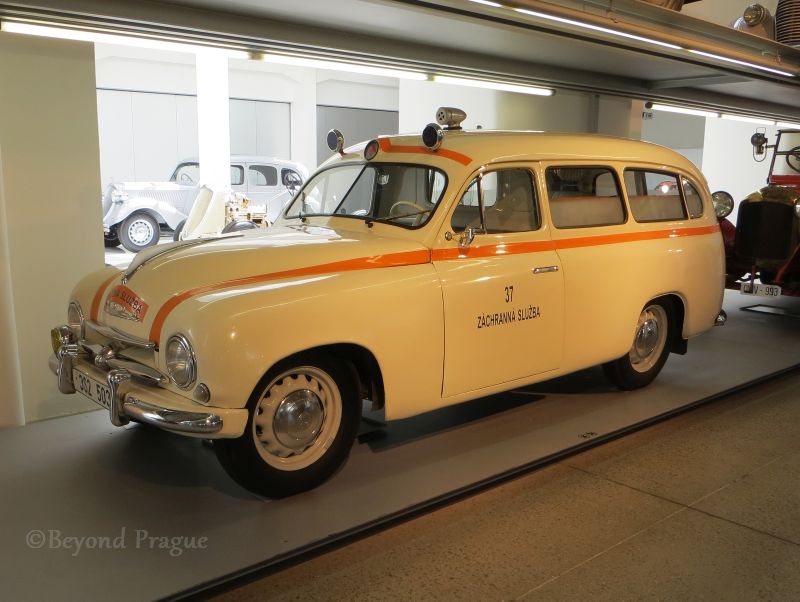
The Tudor was available in sedan form as well as roadster, coupe-cabriolet, station wagon, van and ambulance versions. There was also a military version available with armour.
An extreme variation of the 1101 Tudor came in the form of the Škoda Sport that was introduced in 1949. Designed as an endurance racer, the car was entered in the 1950 edition of the 24 hour Le Mans race and made a very good showing for itself until the 121st lap when a small technical problem forced the Škoda team to withdraw from the race. Perhaps the saddest aspect of this was that the problem was minor and fixable, but the rules of the race stated that technical problems had to be fixable with tools carried aboard the cars; the team did not have the needed tools in the car.

Despite the problem, the Škoda Sport had been an impressive competitior in the field and had certainly been in contention for victory in its class.
The car was more fuel efficient than most of its competitors. It was possible to drive it for four hours on a single tank of fuel, this allowed the team to make fewer pit stops than others during the race.
The Škoda Sport also showed that the company was still a force in motorsport, just as they had been before the Second World War
A critical event in Czechoslovakia in the late 1940s was the Communist coup of 1948 and the nationalization of all industries that followed it. The domestic automotive industry was profoundly affected. The effects were both positive and negative for Škoda.
At the time of the outbreak of the Second World War, Škoda was the leading domestic automobile maker. The many modernisations to production that Škoda implemented after taking over Laurin & Klement allowed them to pull ahead of Praga and Tatra through the 1930s.
With the planned economy that was part of the nationalization, Praga lost their entire stake in passenger automobiles and were limited to producing large trucks and producing other companies’ products. Tatra was allowed to remain in passenger cars, but only at the higher end luxury level. Beyond their luxury cars, Tatra was limited to large vehicle production.
On the downside, Communism and nationalization cut Škoda off from most of the design influence and knowledge sharing from “Western” countries. However, they were left with the economy and family car sectors of the domestic market almost all to themselves to dominate.
In spite of political changes, Škoda was still a respected brand of car and demand for their cars remained strong abroad as well as at home. The company was heading into the 1950s on a largely high note.
Post-war Modernisation
As was the case between the world wars, the 1950s was a period of rapid development in many industries.
In 1952, Škoda introduced the model 1200 as a successor to the Tudor series.
Classified as a family car, the 1200 was available in sedan, station wagon and ambulance versions.
While the 1200 had somewhat smoother body work than the Tudor and was faster due to a more powerful engine, it still featured many aspects of 1940s design.
The 1200 was produced from 1952 to 1956. The 1200’s successor, the model 440 Spartak, would represent a truly modern design from the company and serve as a template for Škoda cars until the late 1960s.
The model 440 was introduced in 1955. As opposed to the 1200, the 440 was a smaller car aimed at individuals rather than families. Further developments in engine, transmission and other technologies led to the more refined models 445 and 450 in 1957.
The 440, 445 and 450 were produced until 1959. Across the three models, around 85,800 cars were built. They were popular abroad as well as at home. Many were exported to western Europe as well as New Zealand and South America. The cars of this series had a reputation for reliability and being economical to operate; the relatively low purchase price also made them winners.
Swinging into the 60s
Skoda entered the 1960s on a high note with two models that would become icons of the brand: the Felicia and the Octavia.
The Octavia was introduced in 1959 and was a modernization of the model 440 Spartak.
While the Octavia retained an external similarity to the Spartak, there were many changes under the skin. The Octavia had an improved and easier to read instrument panel as well as a completely redesigned front suspension.
The Octavia quickly became a popular car at home and abroad, developing a reputation for dependability as well as economic operation and very good handling qualities.
Produced from 1959 to 1971, the Octavia existed in both sedan and station wagon variants for the regular consumer market as well as a more powerful touring version for motorsports.
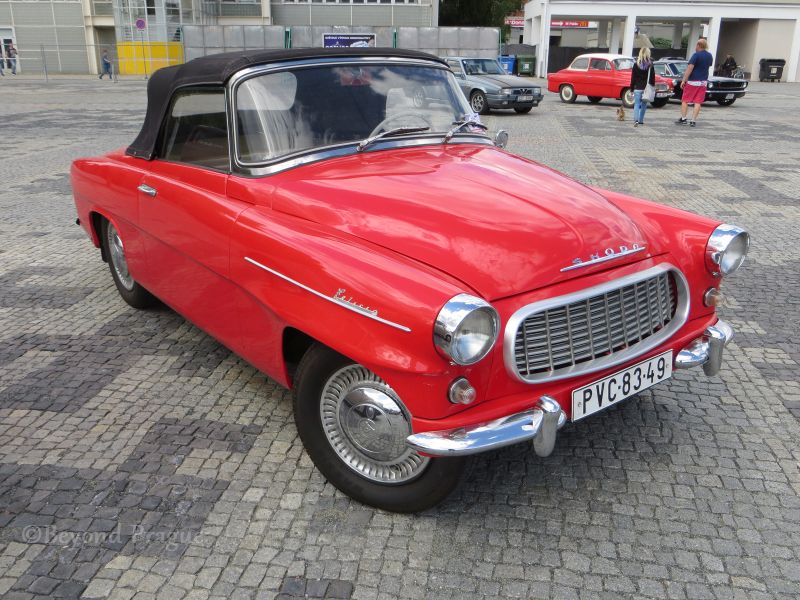
The Felicia also debuted in 1959 and was developed from the model 450. Where the Octavia filled the role of a family car, the Felica was a sporty roadster convertible that came in soft-top and hard-top options.
While the Felicia was only produced from 1959 to 1964, it had many of the same modernizations as the Octavia did and enjoyed a good deal of popularity at home and abroad.
In spite of the popularity of the Felicia and Octavia, it was with these two models that Škoda lost their place on the American car market. Though there was nothing wrong with either car, Cold War tensions of the period and the Felicia’s inability to compete in price and comfort with domestically produced cars of similar class saw the company leave the American market.

1964 saw the introduction of the fully modern model 1000 MB, the successor to the Octavia and Felicia.
Unlike the Octavia and Felicia, the 1000 MB was a fully new design with no connection to previous models.
Škoda began design work on what would become the 1000 MB in 1955. Intended as a family sedan that put light weight and fuel economy at the forefront of considerations, the 1000 MB was a full departure from what had gone before it in the company catalog.
The new car featured a rear mounted engine and rear wheel drive, allowing it have a generously sized luggage carrying ability at the front end. Additional storage space was provided via the folding rear seat. The front seats could recline, which added to the model’s ergonomic value.
The 1000 MB featured monocoque body construction as a way to reduce weight. Unlike traditional construction methods where a separate body shell is built onto a frame, monocoque construction incorporates the body shell into the structure. This reduces the amount of construction material needed as the vehicle takes its structural strength from the body shell rather than an underlying frame. In using this construction method, Škoda achieved their goal of low weight and good fuel efficiency in the 1000MB.
The 1000 MB did very well at home and on export markets. Of particular note was the model’s success on the British market, where it outperformed several deomestic designs where value for money was concerned.
The 1000 MB also served as the basis for the 1000 MB Rallye and 1000 B5 rally cars.

Rallying Through the 70s and 80s
As early as 1965, Škoda had been working on a desgn to replace the 1000 MB.
In 1969, that replacement hit the market as the Model 100. The model 100 used the 1000 MB as a starting point, but there were many changes all around.
While the model 100 kept the engine at the rear and few changes were made to the engine, significant modernizations were made to the front suspension. The interior was modernized from both practical and aesthetic standpoints, while the body structure was reworked and made stronger.
Between 1970 to 1972, Škoda introduced the various members of the model 110 series. The 110 L and 110 LS were sedans that were refined and slightly more powerful variations of the 100. The model 110 R was a sports coupe variation with enough power to push the car to speeds over 140 kilometers per hour.
The 100 and 110 model lines saw great popularity at home and abroad.

As with the 1000 MB before them, the 100 and 110 series were modified as rally cars. Primary among these were the 120 S Rallye, produced from 1972 to 1976, and the 130 RS which was produced from 1975 to 1980.
Both rally types were strong competitors and kept Škoda a name to be respected in international motorsports. The 130 RS represented the company at international rallies until the end of the 1984 season
Of the two, the 130 RS is considered to have near legendary status for the number of high ranking finishes it had and is seen as very collectible by vintage car enthusiasts.
In 1976, Škoda introduced the 742 series to replace the 100 and 110 models. This series was produced from 1976 to 1990, total production was over 2 million units. The cars of the 742 series are sometimes collectively known as the Škoda Estelle.

The basic design of 742 series cars was fully new and included modern body work of more angular design that included deformation zones. New manufacturing processes also reduced production time per vehicle, thus increasing factory output.
Cars of the 742 series also benefited from modern finishing technology that gave improved resistance to corrosion.
The 742 series was comprised of the 105, 120, 125 and 130 models. As with the 100 and 110 they were designed to replace, they were four door sedans set apart from each other by slight engine power differences and small design refinements over the course of the production run.
Just as the 110 R represented the sporty side of the 100 and 110, the 743 series did the same for the 742 series. The 743 series consisted of two models, the Garde and the Rapid. Both were introduced in 1981, with the Garde being produced until 1984 and the Rapid until 1990
In 1984, a rally version was developed from the 742 series and called the 130 LR. It was produced from 1984 to 1988 and was the replacement for the 130 RS.
In 1987, Škoda introduced the 781 series to replace the 105 and 120 models of the 742 series. The company revived the Favorit name for models in the 781 series, a name it had used for an earlier series of cars in the 1930s.
The new Favorit was an attempt to produce something more modern and in line with automobile design philosophies at the time in western Europe. For the body design, Škoda turned to the Bertone design group in Italy. Škoda also moved the engine to the front of the car and mounted it transversely.
The Favorit fit into the subcompact category of cars and was generally well received at home and abroad. More importantly, it served as a critical stepping stone to the next era of the company’s existence.

The 1990s and New Roads
The fall of Socialism in Europe through the late 1980s and early 1990s affected Škoda just as much as it affected all other companies in former Socialist European countries.
The main change was the shift from being state owned to being privately held companies. The government of the former Czechoslovakia issued a tender in 1990 to privatize Škoda Auto. Over 20 companies initially expressed interest in the tender and it ultimately ended in a competition between Volkswagen of Germany and Renault of France.
Of the two bids, Volkswagen’s was more attractive. Unlike Renault’s bid, Volkswagen intended to keep the Škoda brand alive and keep aspects of Škoda, such as their research and development department, intact and operational.
In December of 1990, Volkswagen was officially declared winner of the tender and Škoda would spend the 1990s as a partial subsidiary to the German company.
Many Czechs with a more pessimistic outlook will say that this period of time is when Škoda stopped being a Czech company and became a German one. However, Volkswagen has been very respectful of Škoda as a subsidiary and the long history attached to the brand. Had Volkswagen not won the tender, the Škoda Auto brand would likely have been consigned to the history books in the early 1990s as Renault’s bid did not include keeping the Škoda brand active.
At the time of Volkswagen taking Škoda as a subsidiary, the Czech company was still producing versions of the Favorit. They had developed a station wagon verision, known as the Forman, and a pick up truck variation by the early 1990s.
In 1994, the new Škoda Felicia was introduced. It was the first new Škoda car following the Volkswagen takeover and it put some much needed new wind in Škoda’s sails.
The new Felicia was an extensive reworking of the Favorit that featured smoother body design and a wealth of modern features under the skin that made it fully competitive on the rapidly changing European markets.
The Felicia was produced from 1994 to 2001 and it was built in station wagon, pick up truck and van variations.
The importance of the new Felicia can’t be understated, it was the model that helped win Škoda a lot of respect that the brand had lost in some European markets through the 1980s.
Many cars Škoda produced in the 1980s suffered reliability issues, or simply were seen as dated in their design and technology. This resulted in the brand becoming the subject of many jokes, particularly among British motorists.
Three short years after the Felicia was introduced on the British market in 1998, it placed first in national surveys of owner satisfaction.
The Felicia put Škoda back in fighting form and set the stage for greater things.

2000s: The New Generation
The Felicia was not the only legacy name renewed from the Škoda catalog in the 1990s. 1996 saw the Octavia name revived.
However, by 2000, Škoda was a full subsidairy to Volkswagen and had introduced the Fabia to replace the Felicia.
The Fabia family has been a remarkably successful model range for Škoda. It has remained in production, across four model generations as of 2022, since 1999. If the Felica brought Škoda back to form, the Fabia has done much to keep them on form since.
To meet the global demand; Fabia production lines have existed in: Algeria, Bosnia and Herzegovina, China, India, Kazakhstan, Kenya, Poland, Russia, and Ukraine as well as in the Czech Republic.
The Fabia has been made in hatchback, station wagon and sedan verions.
Since 2003, rally modified verions of the Fabia have been keeping Škoda competitive in international motorsport.
Škoda also used the Fabia to break into the minivan market as they used it as the starting point for their Roomster model which was produced from 2006 to 2015.
The Suberb model name was revived in 2001. As it did in the 1930s and 1940s, the Superb name represents the luxury end of things for Škoda. The revived Superb line remains in production as of 2023.
The 2000s also saw Škoda enter the sport utility vehicle (SUV) market with the Yeti in 2009. The Yeti proved popular and was in production until 2017.
To the Present: Heritage and Vision
Since 2010 Škoda has been building their presence on the SUV market with the Kodiaq, Karoq, Kushaq and Enyaq model lines.
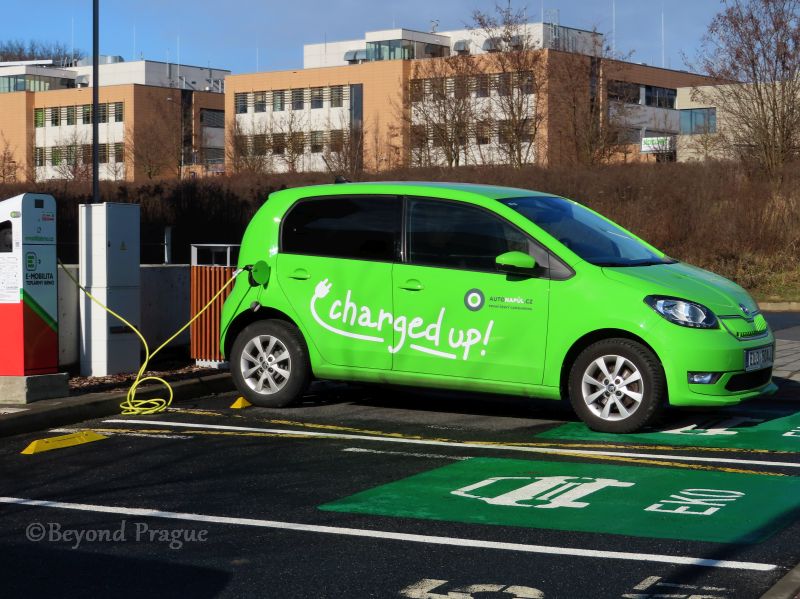
The company spent a great deal of time developing electric cars through their own Vision series of prototype vehicles. That research resulted in electric powered options for some of their models. Škoda marks the electric powered models with the “iV” suffix. Electric powered versions of the Citigo, Enyaq, Octavia and Superb families have been available since the 2019 to 2020 timeframe.
While keeping up with current automotive development trends, Škoda keeps in touch with their history. In the 2013 timeframe, they introduced the option of “Laurin & Klement” trim on some models.
A Škoda car with “Laurin & Klement” trim represents the highest level of luxury and features offered on that model. Octavia, Superb and Yeti are some of the models where “Laurin & Klement” trim is available.

Learning More
As Škoda is a dynamic company, it’s difficult to say where they could go next. A visit to the official Škoda website is not only a good start to see what the company is currently doing, but also see some their history.
A visit to the Škoda Motorsport website will give you a wealth of information on the company’s activities in that regard.
If you’re in the Czech Republic, a visit to the Škoda Museum in Mladá Boleslav is certainly something to put on your itinerary if you want the fullest picture of the company.
 Beyond Prague