
Get on Your Pig and Ride!
Motor scooters are a very popular way for people around the world to get around, particularly in crowded cities where parking for traditional four-wheel cars tends to be at a premium. Indeed, the entire point of the motor scooter as a vehicle has always been to balance economical operation with practical utility.
The real heyday of motor scooters stretched from the immediate post–Second World War years to the late 1960s. Two of the earliest and best known scooters of this period came from Italy: the Piaggio Vespa and the Innocenti Lambretta. Both types were immediately popular, as the era in which they debuted was marked by recovering post-war economies across Europe where many things—particularly petrol—were still strictly rationed.
Through the 1950s, more companies around the world began producing motor scooters as demand grew. By the late 1950s and into the early 1960s, the motor scooter had truly come into its own as a popular vehicle among youth. It became a symbol of status and affordable freedom for young people with lower-paying jobs. The scooter even became an inseparable part of the Mod subculture, which flourished in Great Britain from the late 1950s to the mid-1960s.
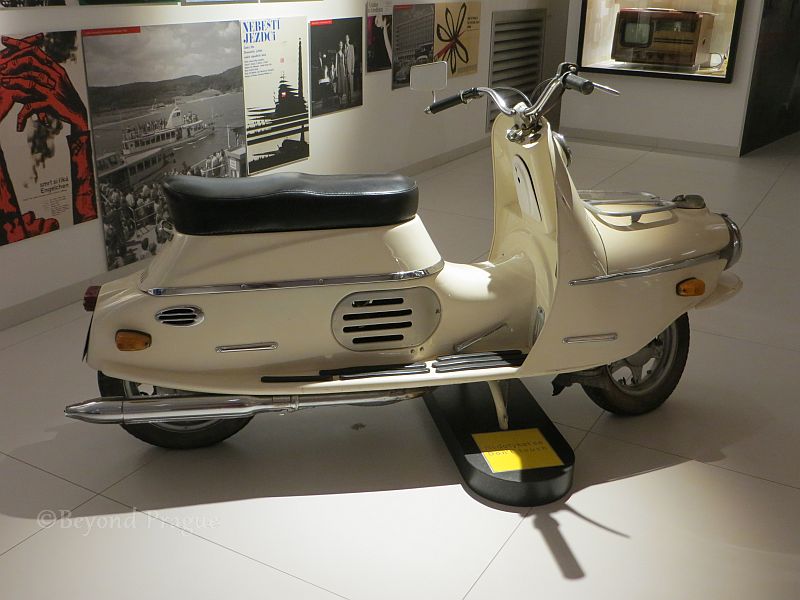
The Čezeta debuted in 1957 and was the former Czechoslovakia’s contribution to this golden age of motor scooters. Immediately distinguishable from its contemporaries thanks to its very different design—which featured a long front section ahead of the driver terminating in a single headlamp—this characteristic gave the scooter the affectionate nickname of “Pig” in its homeland. With its long snout, the Čezeta did indeed resemble that particular farm animal.
The Čezeta exists today in both classic and modern forms. The classic line was produced from 1957 to 1964 and encompassed three versions. The Čezeta was revived in modern form in 2017; though the classic shape was retained, the modern version proved to be a very different breed of pig altogether.
Let’s spend some time with the Čezeta:
The Right Man for the Job
The Čezeta was designed by Jaroslav František Koch (1893–1983). Born in a small village near Prague, Koch studied industrial design and spent the First World War and immediate post-war years working for aircraft companies.
An accomplished motorcycle racer, Koch was responsible for designing the legendary Praga BD 500 series of motorcycles, produced between 1927 and 1935.
In 1940, shortly before being hired by Česká Zbrojovka (ČZ) at the company’s Strakonice factory, Koch patented a scooter with a revolutionary monocoque design. A monocoque design uses the vehicle’s body shell to provide structural integrity and strength rather than relying on a separate internal frame. The biggest advantages of a monocoque frame were savings in both materials and weight.
ČZ Strakonice went on to become one of the world’s most prolific and successful producers of racing motorcycles from the immediate post–Second World War years through the mid-1980s. Koch was truly in his element, and it was during his time at ČZ that he designed the Čezeta.
A Scooter Apart
The design of the Čezeta represented a clear departure from its contemporaries. Beyond meeting the basic requirements to classify as a scooter for licensing purposes—and offering young people in Czechoslovakia and other then-Socialist countries in Europe the same taste of affordable freedom that Western scooters gave youth elsewhere—the Čezeta was, in many respects, a very different animal.
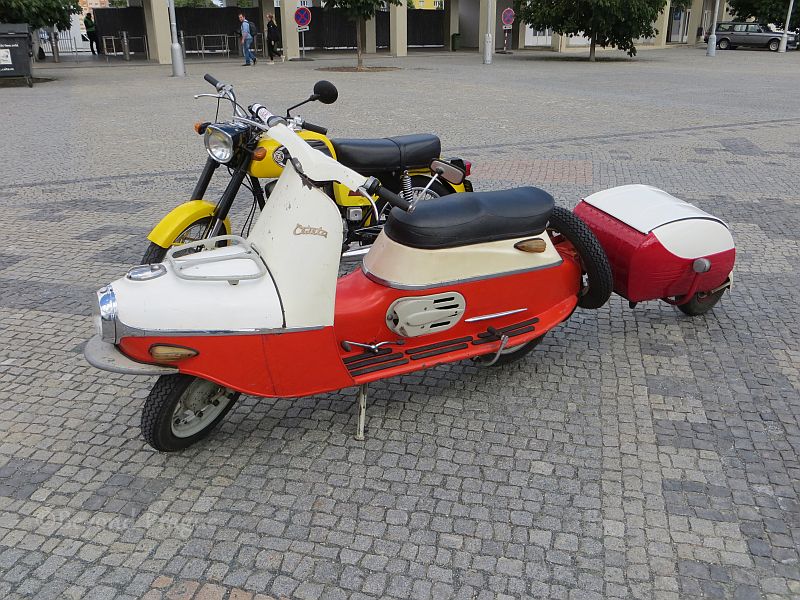
Aside from its monocoque body design and distinctive “snout,” the Čezeta also featured a notably longer wheelbase than other scooters. These design choices gave it a very strong structure, better ergonomics for both driver and passenger, and improved cargo-carrying ability. The “snout” was key to this capacity: it allowed the fuel tank to be placed over the front wheel, thereby freeing up more storage space under the seat. It also created room for a small luggage rack on the front section of the scooter.
The classic Čezeta line comprised three series: the 501, 502, and 505. The 501 and 502 were scooters in the truest sense, while the 505 brought the vehicle’s utilitarian qualities to the forefront.
The 501 series, built between 1957 and 1960, included six sub-variants, primarily differentiated by changes in the engine and cooling system.
Debuting in 1960, the 502 series introduced several improvements, including better suspension and an upgraded starting system. It also featured a modest increase in maximum speed and significant enhancements in cargo and passenger capacity, notably through an available trailer and the option to fit a sidecar. The sidecar, manufactured by Drupol, was named the “Druzeta.” The 502 series was produced until 1963 and included four sub-variants.
An interesting chapter in the Čezeta story occurred in 1960 with the debut of the NZeta—a licence-produced version made in New Zealand using imported Čezeta components combined with 25% locally produced parts, in accordance with import laws of the time. NZeta production lasted three years.
Built between 1962 and 1964, the 505 series combined the front end of the 502 with a steel rear frame to create a tricycle-type vehicle with a focus on transport. The 505 could be fitted with a variety of rear cargo bodies, including flatbed and cargo-box options, as well as a van body with a fully enclosed cabin for the driver.
With a maximum hauling capacity of around 200 kilograms, the 505 was well-suited for small-scale delivery and courier work, as well as light transport around agricultural and industrial sites.
All members of the classic Čezeta line could be fitted with an optional clear plastic windshield for improved protection from debris.

The “Pig” Today and Learning More
Roughly 20 years after the last Čezeta was built, ČZ Strakonice faded from the motorcycle manufacturing landscape, and the scooters they produced became collectible rarities. Today, the best chance of seeing one of these classic machines is at a vintage automobile event or museum in the Czech Republic.
A brief revival of the Čezeta brand came when the rights to the name and design were purchased by Prague-based British expatriate Neil Eamonn Smith. Smith founded Čezeta Motors s.r.o. in 2013 and began developing a new generation of Čezeta scooters. The first of this new generation debuted in 2017 as the Series 506.
While the new scooter faithfully preserved the classic look, everything else had changed. The 506 series was fully electric rather than petrol-powered and featured a composite body shell over an internal frame, as opposed to the metal monocoque construction of the classic series.
The new Čezeta was planned as a limited, built-to-order model aimed at buyers with a taste for nostalgia rather than utility.
Ultimately, only 60 examples were produced. The 506 series was not considered commercially successful, and Čezeta Motors s.r.o. incurred heavy debts. Attempts to sell the company were unsuccessful, and it was declared bankrupt in 2022.
For those wishing to learn more, this informative website is dedicated to the NZeta model produced in New Zealand in the early 1960s. This 2022 CzechCrunch article also offers insight into the rise and fall of Čezeta Motors s.r.o. The latter is in Czech but translates well through online tools.
 Beyond Prague