
Spas and Sanitariums
Kuks is a small village in the north-central part of the Czech Republic that sits on the Labe (Elbe) river.
The town’s quiet nature belies a history as a meeting place for members of high society and a spa town with a wide reaching reputation for its curative waters.
The history of Kuks as a town began in the 1680s, when the land it sits on was inherited by Count Franz Anton von Sporck (1662-1738). The count had the water of local natural springs tested and found very suitable for spa use; he then set a goal for making Kuks into a world class spa town.
The count suceeded in realising his goal and Kuks became a truly lavish place that attracted nobility as well as artists. Notable among those artists was Matthias Braun (1684-1738), a prominent sculptor and master of Baroque style in the Bohemian region. Braun created many statues and carvings in Kuks that survive to the present.
While the left bank of the river served as the spa resort and entertainment centre, the right bank became the site of a hospital that was built in stages between 1707 and 1748.
The town’s heyday as a spa resort was short lived. A flood in 1740 destroyed a great deal of the infrastructure that supported the spas; as the count’s descendants had no interest in maintaining the spas, they were never rebuilt and Kuks faded from prominence to a quiet village.
Today, the townsite retains some architecture and other features from the spa resort period. The restored hospital serves as the town’s main tourist draw.
Let’s spend some time with Kuks hospital:

Made by Masters
Kuks hospital is, at a global level, considered a very important example of Baroque architecture.
This should not be a surprize as Count Sporck entrusted the design of the hospital to the very capable hands of Italian architect, Giovanni Battista Alliprandi (c.1665-1720).
Alliprandi was among the most important and respected of architects working in Baroque style in Bohemia at the time. The count had already used his services in the design of spa houses in the town. Aside of his work in Kuks, over 20 of Alliprandi’s other works can be seen in various parts of the Bohemian regions today.
Alliprandi began design work with the core structure of the hospital; the Church of the Holy Trinity and the Sporck family crypt beneath it. The church was built between 1707 and 1715 and consecrated in 1717.

As the hospital structure grew from the sides of the church, more artful touches were added in the form of statues designed by Matthias Braun. These were added between 1712 and 1731.
Braun’s contribution included 24 allegorical statues of human vices and virtues, they are considered some of his most important works.
The original statues are on display in the hospital’s lapidarium, while replicas occupy their original places outdoors.
As with Alliprandi, Braun is considered one of the most important practitioners of Baroque style operating in Bohemia during the era.
The Merciful Brothers
In 1743, five years after Count Sporck’s death, administration of the hospital was given to the Spanish Order of the Hospitaller Order of the Brothers of Saint John of God — known as the Merciful Brothers for short.
It was under the order’s tenure that the facility became a hospital in the true sense of the word.
Prior to the order’s arrival, it served as a care centre for old men and military veterans in the region. While the order continued that work, they also added a dedicated hospital section and pharmacy that could serve the surrounding area as well as the residents.
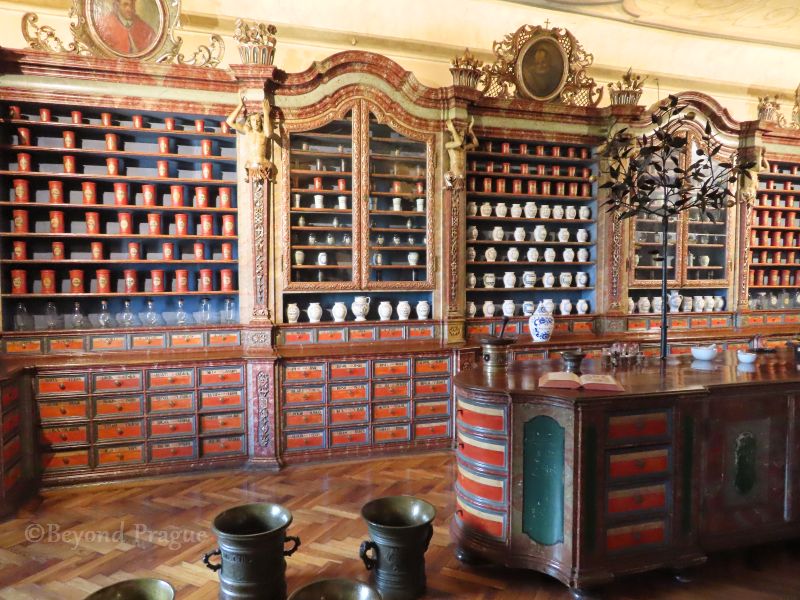
On a basic tour of the hospital, you can see the Pomegranate pharmacy. The pharmacy is restored to the arrangement it had under the order’s watch, so is a good example of a Baroque style pharmacy and medical knowledge of the period.

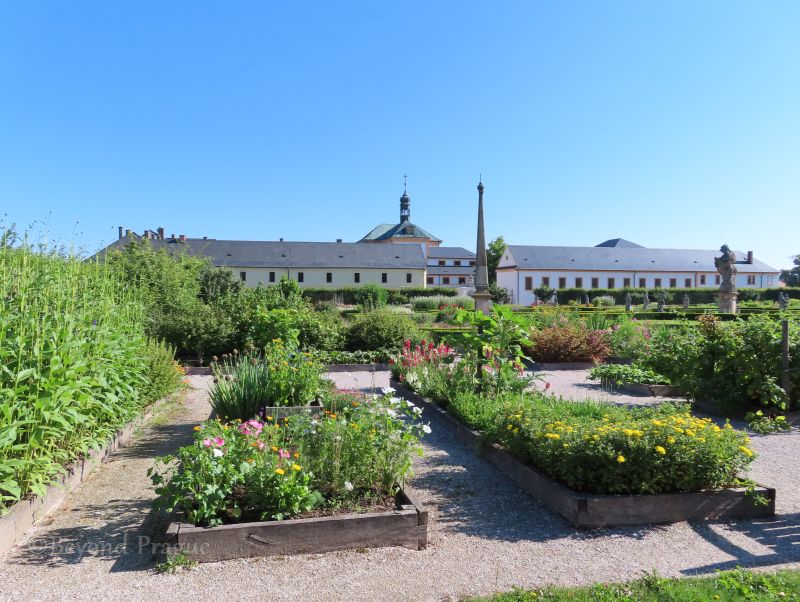
While you take in the pharmacy, keep in mind that many of the curatives there were grown in the herb garden behind the hospital.
The garden was in place prior to the arrival of the order, but they most certainly made good use of it and added their own enhancements to it.
The order’s oversight of the hospital came to a sudden end in 1938 when occupying German forces expelled them and shut down the hospital. During the Second World War, it was used as a detention centre for boys.
The facility was taken under state control after the Second World War.

State Control and Restoration
For several years after the state took control of the hospital, it continued to serve practical purposes.
Until the late 1960s, part of it was used as a care centre for the chronically ill. Until the 1990s, part of it was used to house a branch of the regional archives.
Over the years, many areas of the hospital fell into heavy deterioration and a number of efforts were made to undo the damage. One such effort included an extensive and costly renovation between 2010 and 2015 that was of such high quality that it won the Europa Nostra Grand Prix award in 2017. Europa Nostra is an organization dedicated to recognizing and preserving cultural heritage across Europe.
A notable aspect of the 2010-2015 renovations was the discovery and restoration of a cycle of wall murals in the main corridor based on the allegorical Dance of Death theme.

Paying a Visit and Learning More
Kuks can be accessed by both road and rail. The bus stop is on the village side of the river, while the train station is a short distance behind the hospital.
We travelled there by rail as a day trip during a week of holidays in Hradec Králové. It wasn’t a long or difficult trip, but it did require one change of trains.
We limited our visit to just the hospital, but the village has more on offer than that. If you are at all a fan of Baroque architure and style, you would certainly find a visit to Kuks worthwhile if you find yourself in the area.
Kuks hospital offers four different guided tours. Visit the official hospital website for more details on the tours, opening ours, and details on how to get there.
A visit to the the Kuks tourism portal will tell you more about the hospital as well as what else the village and surrounding area has on offer for visitors. It is only in Czech, but responds well to online translator functions.
 Beyond Prague