
A Pocketful of Culture
Tucked into the far reaches of Eastern Bohemia, in the Bohemia–Moravia borderlands, is the historic city of Litomyšl.
Home to a UNESCO World Heritage site and the birthplace of famed composer Bedřich Smetana (1824–1884), Litomyšl is one of the country’s better-known tourist destinations. Many visitors are familiar with it before they even arrive in the Czech Republic.
Officially gaining status as a city in the 13th century, Litomyšl has its origins in 11th and 12th century settlement. Over the centuries, it has served as the seat of nobility and bishops, as well as an important centre of education and culture.
Because of its educational role through the 19th century, Litomyšl attracted many notable names from the Czech arts and culture scene. Their influence can still be seen and felt throughout the city today.
The modern city is keenly aware of its past and uses it to great advantage in welcoming visitors.
With that in mind, let’s spend some time in Litomyšl:
Show Yourself Around
Befitting a place where education and enlightenment have played such a major role, Litomyšl invites visitors to explore on their own. A well-prepared self-guided tour map, available at the city’s tourism offices or online, covers nearly 20 points of interest in the very walkable city centre.
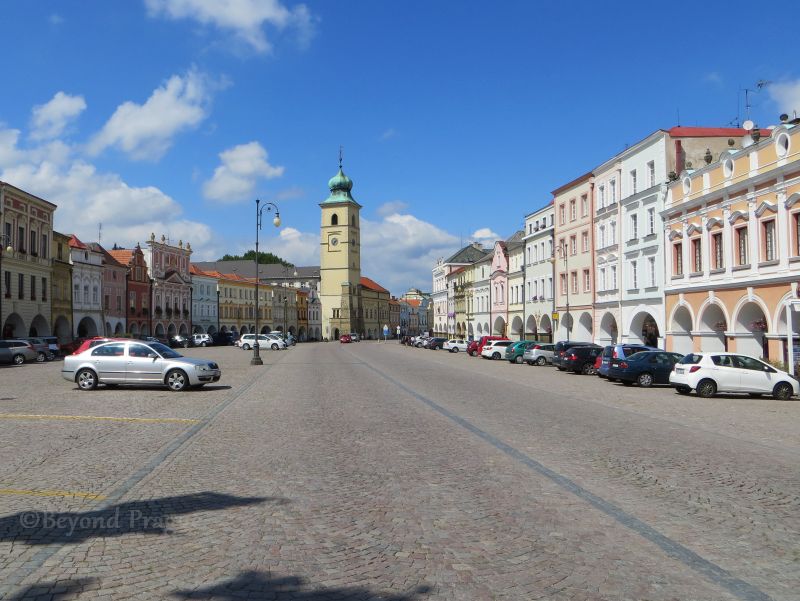
The recommended start and finish point is the 500-metre-long Smetana Square. One of the largest public squares in the Czech lands, it is lined with arcaded facades in Baroque, Classicist, and Renaissance styles. Also on the square stands the Gothic-style town hall tower.
Exiting the square on Jiráskova Street—on the north-east corner of the square—takes you past the statue of Bedřich Smetana and into the vicinity of the Neo-Renaissance Smetana Hall and the Pedagogical High School, decorated with striking sgraffito exteriors.

Further along, you’ll find a monument to writer and educator Alois Jirásek (1851–1930). Jirásek spent several years in Litomyšl as a high school history teacher and is considered one of the most important Czech authors of his time.
Nearby is the Baroque Church of the Discovery of the Holy Cross. It belonged to the Piarist order, who were invited to Litomyšl in 1640. Dedicated to education, the Piarists played a major role in the city’s reputation as a learning centre for centuries. They left in 1948, leaving the church behind.
Climbing the church towers is worthwhile, as the balcony between them offers an excellent view of the chateau.
Between the Piarist church and the city’s other major religious building, the Presbytery Church of the Raising of the Holy Cross, lie the monastery gardens. Left untended and closed to the public for many years, they were restored in the late 1990s into the beautiful and relaxing park visitors enjoy today, framed by the two churches.
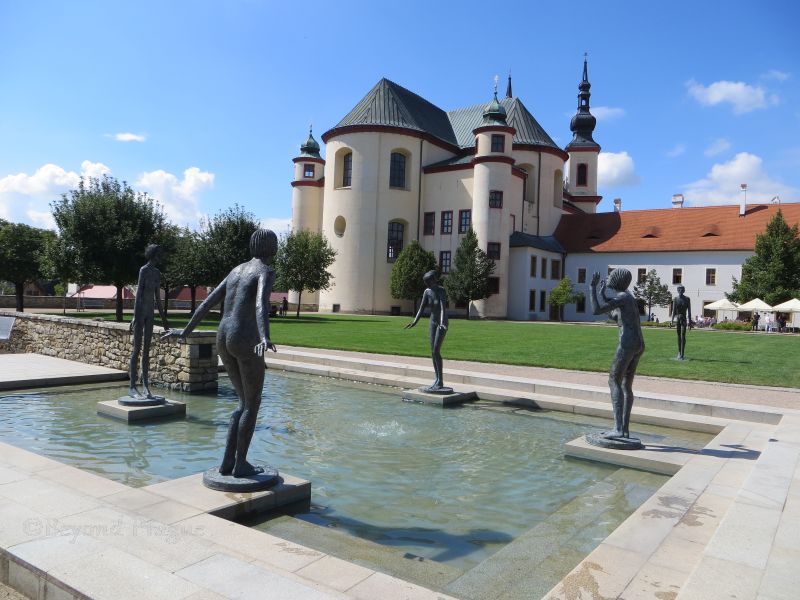
The gardens feature a fountain surrounded by statues by contemporary Czech sculptor Olbram Zoubek (1926–2017).
Leaving the park brings you to the Gothic-style Presbytery Church of the Raising of the Holy Cross. This church originally belonged to the Augustinian order, which had a monastery in the city from 1356 to 1428.
From the Augustinian church, you can head in two directions:
- To the east: A short walk takes you to the Portmoneum, a museum dedicated to Josef Váchal (1884–1969). Váchal was a writer, illustrator, and printmaker with a distinctive, often enigmatic style. His connection to Litomyšl is somewhat tenuous, as he visited only briefly at the invitation of art collector Josef Portman. Portman commissioned him to paint two rooms in his home, resulting in a complex collection of imagery that defies easy interpretation. The art in the Portmoneum is not to everyone’s taste, but those drawn to avant-garde expression may find it rewarding.
- Straight ahead: Following the street directly outside the church entrance takes you to the city’s oldest church and into Váchal Street. This short lane leads back to Smetana Square and is notable for its arches and walls, which are decorated with sgraffito images taken from one of Váchal’s books.
Renaissance Resplendent
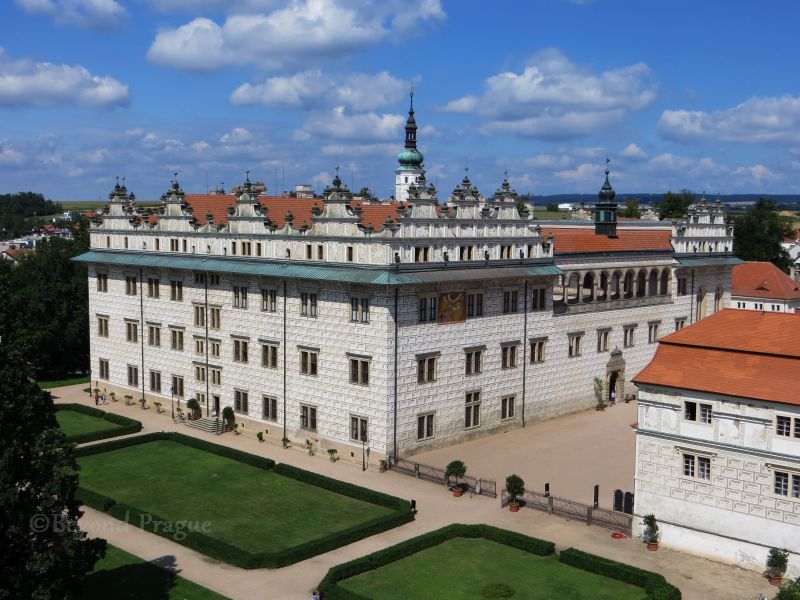
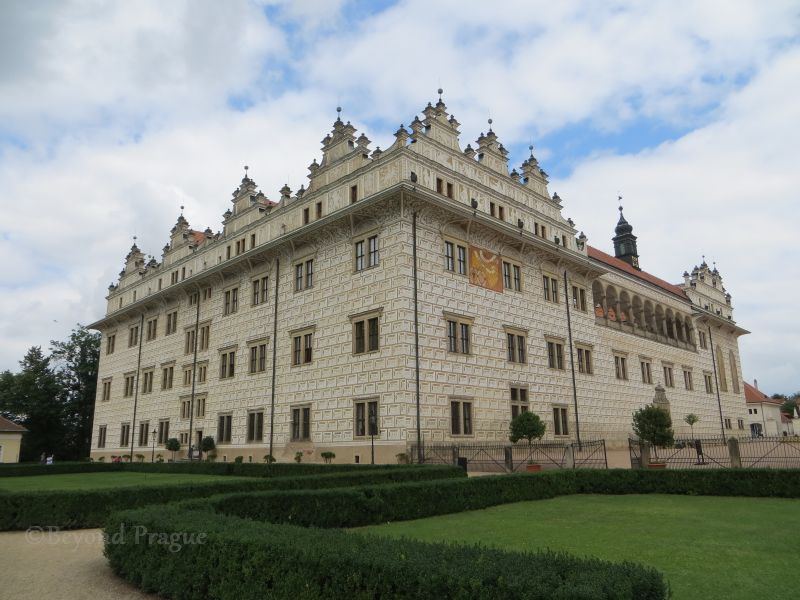
Near the Piarist church stands Litomyšl’s star attraction: the Renaissance-style, UNESCO-listed chateau.
Commissioned by the powerful Pernštejn family and built between the 1560s and 1580s, it was a rare example of an Italian Renaissance arcaded palace outside Italy.
In 1649, the chateau and city passed to the Trautmannsdorf family, and in 1758 to the Valdštejn-Vartenberk family. Under their ownership, the chateau underwent extensive alterations, gaining several Baroque features.
It was during this period that Bedřich Smetana, son of the chateau brewery’s brewmaster, was born in 1824. Visitors to the chateau can still see the apartment where the composer was born.
In 1855, ownership shifted again, this time to the German noble house of Thurn und Taxis. They were the last noble owners, holding the property until the end of the Second World War, when all Germanic families were expelled from Czech lands and their properties seized by the state.

The chateau has remained under state ownership since then, declared a national cultural monument in 1962. Restoration of its extensively sgraffito-covered exterior began in the 1970s, overseen by Olbram Zoubek.
In 1999, the chateau and its grounds were inscribed on the UNESCO World Heritage list. It remains a textbook example of an Italian Renaissance arcaded castle, unique in its preservation and its location outside Italy.

Honouring the Past
As noted earlier, Litomyšl remains deeply connected to its past.
Since 1946, it has hosted the annual classical music and opera festival Smetana Litomyšl, one of the oldest and largest events of its kind in the country. A youth version of the festival has taken place annually since the early 1970s.
Another historic resident, Magdalena Dobromila Rettigová (1785–1845), is remembered through the city’s annual gastronomy festival, held since 2012. Rettigová wrote what was for many years the only Czech-language cookbook: A Household Cookery Book or A Treatise on Meat and Fasting Dishes for Bohemian and Moravian Lasses. First published in 1826, it became a bestseller throughout the 19th century and remains in print today.

Paying a visit and Learning More
Beyond its historic centre, Litomyšl is a fairly typical Czech town with little in the way of tourist trappings. It makes an excellent day trip from several other destinations, though it is not the most straightforward place to reach by bus or rail.
If travelling by train, it’s best to plan your journey to end in Česká Třebová, then take a bus from there to Litomyšl. Regular service runs between the two cities, and the bus platforms in Česká Třebová are directly outside the train station entrance.
To learn more about Litomyšl, its attractions, and its calendar of events, the city’s official website is a great place to start.
The Litomyšl Architecture Manual website is a useful resource for more detailed information about the historical buildings you will see in the city.
 Beyond Prague