

Southern Sweet Spot
Dačice is a town of just over 7,000 people in South Bohemia, roughly 15 kilometres from the Austrian border.
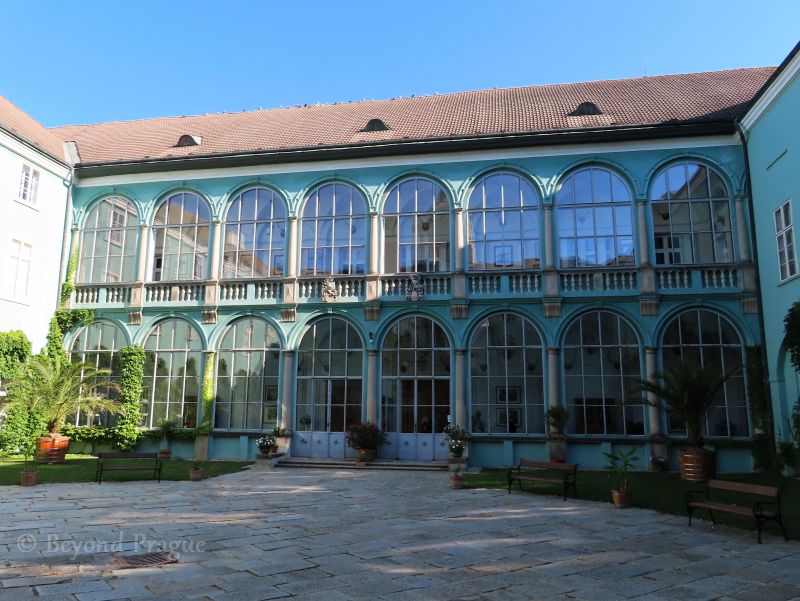
While the town is not touristy, it is home to a distinctive blue chateau that is an intriguing example of a transitional architectural style between Classicist and Empire movements.
Dačice also has the distinction of being the birthplace place of the sugar cube. Not far from the chateau, you’ll find a monument commemorating the invention in 1843.
Let’s take a closer look at Dačice chateau:

Through Many Years and Many Hands
As with many chateaus and castles, Dačice chateau saw many changes in ownership before it was taken over by the state in 1945.
Design and construction were ordered by Oldřich Krajíř (1561-1600), of the noble Krajíř of Krajek family, in the late 1500s. The chateau was completed in Renaissance style in the early 1590s.
The Krajíř line died out in the early 17th century, beginning a turbulent period of rapid ownership changes, legal disputes, and disasters. From 1610 to 1809, the chateau passed through the hands of six noble families before coming into the possession of the Dalberg family, its most significant owners.
Through much of the 1600s, the chateau’s ownership was the subject of protracted litigations that delayed much needed repairs to the structure following two fires.
Stable ownership came to the chateau in 1728, when it was purchased by Count Heinrich Karl von Ostein.
The Ostein family owned the chateau from 1728 to 1809. Under their ownership, the chateau was reconstructed from Renaissance to Baroque style.
1809-1940: The Dalberg Years
In 1809, when the Ostein line died out, the chateau was passed to the Dalberg family. Like the Osteins, the Dalbergs were of Germanic noble origins.
Under the Dalbergs, the chateau experienced a true renaissance, reaching its height as a noble residence. Its current appearance is thanks to exterior reconstructions completed in 1816 and interior renovations in the 1830s, which transformed it from Baroque to predominantly Empire style. The chateau retains some Classicist elements, and the clock tower at its entrance is a reminder of its Baroque past.
The Dalbergs also redesigned the gardens in the English landscape style.
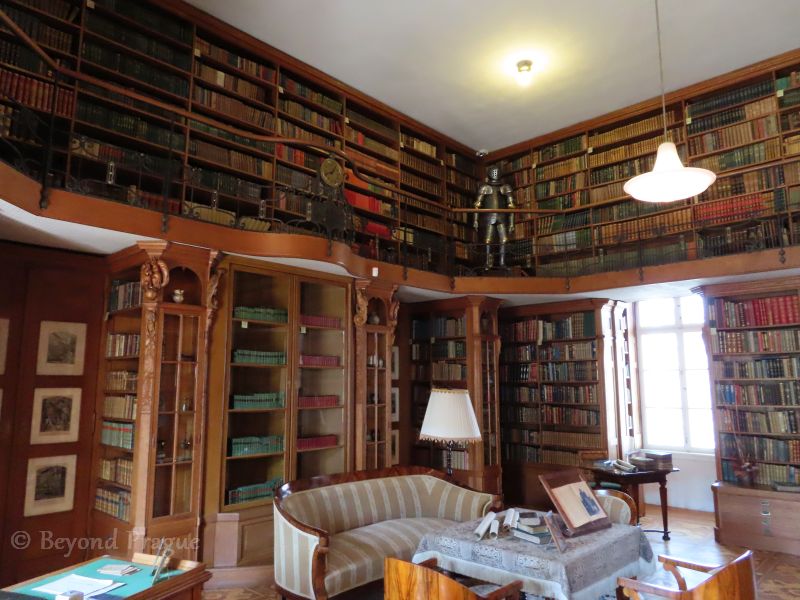
Their cultural legacy included two libraries containing a total of 25,000 volumes. Today, visitors can see both the small library and the grand library, the latter holding around 17,000 books. They also left extensive collections of butterflies and minerals.
The Dalberg family line ended in 1940, and the chateau passed to the Salm family of Luxembourg. They held it until 1945, when—like all other German-owned properties in Czechoslovakia—it was seized by the state after the Second World War.
The chateau opened to the public in 1949 and remains in state ownership today.

Take the Tour
The standard tour of the chateau is dedicated to the Dalberg era, and covers four generations of the family’s life there.
Visitors see both the representative and private rooms of the Dalbergs in a 50-minute experience, including the Classicist-style staircase hall—considered one of the finest examples of Classicist interiors in Central Europe.
Tours are only available in Czech, but texts in English or German are available on request.
The chateau also has a small café where you can get refreshments and light snacks before or after your visit.

A Sweet Story
In addition to preserving the Dalberg legacy, the chateau houses Dačice’s municipal museum.
As mentioned earlier, Dačice is where the world’s first sugar cube was invented in 1843. Jakob Christof Rad (1799-1871), an Austrian physician and businessman, was the director of a local sugar factory.
At the time, sugar was sold in large loaves, which had to be chopped into smaller pieces with a special tool. Rad’s wife, Juliana, injured her finger while chopping sugar and demanded her husband find a safer way to package it.
Rad experimented with a variety of alternate packaging ideas until he arrived at a way to press sugar into uniform cubes. Juliana was pleased and her husband took out a five year patent on his invention.
The south wing of the chateau is where you will find the museum. The museum gives a good amount of space to the importance of the sugar industry to Dačice’s history.
A very short distance from the chateau, you will find a granite monument dedicated to the invention of the sugar cube.

Paying a Visit and Learning More
As mentioned earlier, Dačice is not particularly tourist-oriented.
If you don’t have a car, the train is your best option. Dačice lies on the railway line between Havlíčkův Brod and Slavonice. Trains from Prague to Havlíčkův Brod run regularly—some direct, others requiring a transfer at Kolín. Travellers from Brno will also find direct connections to Havlíčkův Brod.
Probably the most convenient approach is to stay in the more tourist-friendly town of Telč and make Dačice a day trip. Telč is on the same line between Havlíčkův Brod and Slavonice and lies just north of Dačice.
For the latest information on opening hours, tours, and admission prices, visit the official Dačice Chateau website. Details on the municipal museum, including current exhibitions, are available on the museum’s official website.
 Beyond Prague